Laser Hair Removal Business Profitability: A Break-Even Guide
Laser hair removal business profitability depends on whether finished treatments generate enough contribution to cover the costs your model includes. Equipment alone cannot establish a...

HIFU is short for High-Intensity Focused Ultrasound. A HIFU machine works like a magnifying glass that concentrates sunlight: it focuses ultrasound energy onto a precise point beneath the skin, without cutting the surface. The energy heats that small area enough to trigger a natural repair response, so the tissue contracts slightly and then rebuilds itself with fresher collagen over the following weeks.
Focused ultrasound has been used in medicine for years, and in aesthetics it has become a popular alternative to a surgical facelift. Most people choose it because there are no incisions, no needles, and very little downtime. The treatment is often described as a non-surgical facelift, although it is more accurate to say that it lifts and tightens rather than removes excess skin.
A mini HIFU machine is simply a more compact version of the same technology. These units are built for smaller treatment rooms, traveling therapists, and clinics that want to offer lifting without dedicating a large footprint to a single device. The category has grown quickly, because the machine itself is often the main obstacle for a young clinic — and a portable unit removes that obstacle.
A HIFU face lift machine uses the same physics as diagnostic ultrasound, but at much higher intensity. The handpiece sends focused waves through the skin surface to a chosen depth; there, the energy creates small, controlled coagulation points — think of them as tiny heat spots that mark where new collagen should form. Because the surface layer is left untouched, the treatment is non-invasive from the outside in.
The layer clinicians aim to reach is the SMAS, a sheet of connective tissue that supports the cheeks, jawline, and lower face. In a surgical facelift, the surgeon lifts this layer by hand. A HIFU device reaches the same layer from outside the skin: it heats precise points in the deep dermis and the SMAS, which makes the tissue contract and then rebuild itself with denser collagen. The visible result appears gradually, over weeks and months, rather than on the day of the session.
This gradual timeline is worth understanding before any purchase. HIFU does not offer an instant fix, and it does not remove sagging skin the way surgery does. What it offers is a steady, natural-looking improvement for people with mild to moderate laxity, and a way to maintain that improvement over time.
| Approach | Invasiveness | Downtime | What It Does Best | How Long Results Last |
| Surgical facelift | Surgery | Weeks | Removes excess skin; dramatic correction | Often years |
| Thread lift | Small incisions | A few days | Quick lift with dissolvable threads | Months, sometimes a year or more |
| Injectable fillers | Injections | Minimal | Restores volume and contours | Months |
| RF skin tightening | Non-invasive | None | Warms the dermis to tighten skin | Several months |
| HIFU | Non-invasive | Minimal | Lifts deeper support layers and builds collagen | Many months, sometimes a year or more |
Each option has a role. Fillers change volume, threads give an immediate lift, and RF warms the skin from the surface down. HIFU sits in its own spot because it reaches deeper than RF and targets the support layer that fillers and threads cannot touch — which is why many clinics treat it as the backbone of their non-surgical lifting menu.
An RF microneedle machine takes a different route. Tiny needles create micro-channels in the skin while radiofrequency energy heats the dermis from inside, so the treatment targets texture more than structure: large pores, fine wrinkles, acne scars, and dullness. HIFU reaches deeper and builds support; RF microneedling works closer to the surface and refines the skin itself.
For practitioners, the two technologies complement each other instead of competing. A fractional RF microneedle machine treats skin quality in the upper dermis and supports collagen and elastin remodeling — the two proteins that keep skin firm and springy — while HIFU handles the deeper lifting. That is why multifunctional platforms that combine both have become common in the industry: a patient can receive a lifting plan and a skin-refining plan in the same room, from the same device. This all-in-one idea is also the main difference from single-function machines, which handle one depth and one job.
A typical session starts with a consultation, because the right depth depends on the treatment area and the condition of the skin. The practitioner places a handheld applicator on the skin, and the device delivers short pulses of focused ultrasound. Most people feel a warm sensation or a mild prickling as each pulse lands; the forehead and jawline are usually the most sensitive spots.
Because a HIFU-only pass involves no needles and no open wounds, most patients return to normal activities the same day. When RF microneedling is added, a topical anesthetic may be applied first, and the skin can look red for a few hours afterward. Results build gradually, which is why a course of sessions is usually planned, with maintenance treatments later to hold the improvement.
Not every portable unit is equal, and a few details decide whether a machine is a good fit for a clinic:
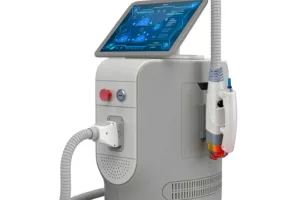
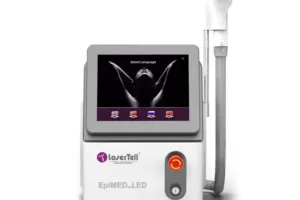
The LaserTell Portable 4-in-1 Aesthetic System brings the ideas above together in one compact platform. It combines HIFU, RF microneedling, ice cooling, and a cold hammer function, so a clinic can offer lifting, tightening, and skin-refining services without filling the treatment room with separate machines.
The HIFU module includes a multi-row ICE HIFU12 handpiece and a single-point ICE Vmax handpiece, giving the practitioner a choice between covering a wider area and targeting one precise point. The RF microneedling module, built around the Crystallite Depth 8 configuration, adds the skin-refining half of the treatment. The ice cooling and cold hammer functions round out the session as a soothing step for patient comfort, which matters more than it may seem in a busy clinic.
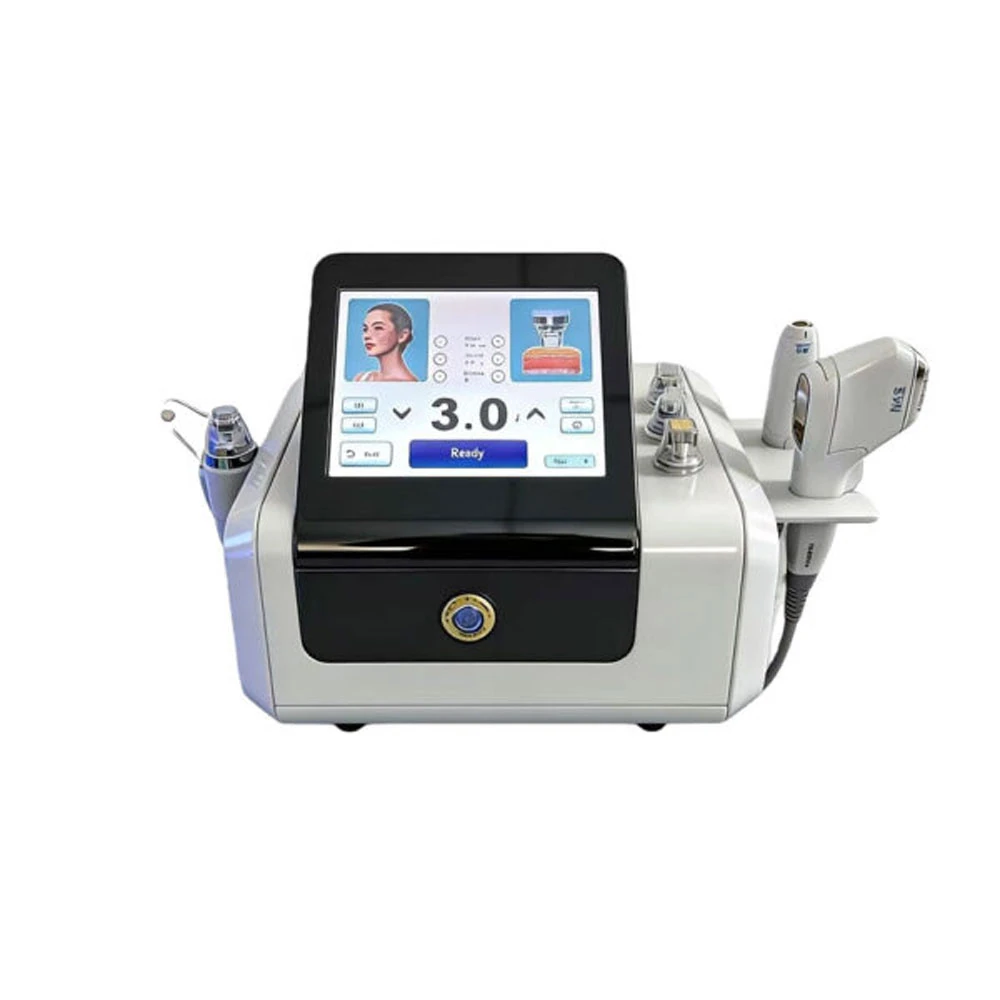
Treatment depth and energy are adjustable, so the operator can match the settings to the area and the patient rather than forcing every case into one profile. The configuration includes a single-point handle and a single-row handle, with treatment heads such as S1.5, N3, N4.5, P1.5, P3, and P4.5 to suit different depths and zones. The HIFU side also includes an ultrasound cannon function, which spreads focused energy across a broader treatment area for larger zones such as the jawline and body work, while the single-point applicator handles precise spots. This flexibility is what separates a multifunctional platform from a single-trick device.
Consider a beauty clinic with a small treatment room that wants to expand its menu without buying three devices. A single portable platform covers the lifting work with HIFU, the texture work with RF microneedling, and a cooling step in between, so the staff can select the right technology for each treatment goal while keeping the equipment footprint modest. Treatment parameters, session frequency, and expected results should always be determined by trained professionals, following the user manual and applicable local regulations.
The system is also designed with daily use in mind: an integrated cooling system and temperature monitoring support consistent performance in a typical professional environment, and the machine should be kept in a dry, well-ventilated environment and protected from extreme temperatures, moisture, dust, and mechanical shock, like any precision equipment. The ice cooling and cold hammer functions fit into a normal session flow as a complementary step in a skin-care protocol, so a patient can finish a treatment comfortably without the clinic needing a separate cooling device. The focused-ultrasound delivery design — applied across the handpiece, the transducer, the treatment head, and the internal energy-control system — is part of the product’s patent-protected engineering. The system is available with CE and RoHS compliance documentation for applicable markets, and it is designed for aesthetic clinics, beauty salons, skin care centers, and equipment distributors.
HIFU means High-Intensity Focused Ultrasound. A HIFU machine delivers focused ultrasound energy to selected tissue depths and is commonly used in aesthetic applications such as skin lifting and skin tightening.
A HIFU face lift machine is designed for non-surgical facial lifting, skin tightening, contouring, and collagen remodeling applications.
HIFU uses focused ultrasound energy and can target deeper tissue layers, while RF microneedling uses micro-needles to deliver radiofrequency energy into the dermis. The two technologies can complement each other in a multifunctional aesthetic treatment platform.
The LaserTell system is marketed as a portable multifunctional aesthetic platform. “Mini HIFU” can be used as a search keyword for compact or portable HIFU equipment, while the exact product classification should follow the product specifications and local market requirements.
Yes. It is marketed as a Portable 4-in-1 Aesthetic System designed to combine multiple aesthetic technologies in one platform.
Non-surgical lifting has changed what a small clinic can offer. HIFU reaches the deeper support layers of the face, RF microneedling refines the skin from within, and portable multifunctional systems bring both into a modest treatment room without a large investment in space. For clinics ready to add these services, the LaserTell Portable 4-in-1 Aesthetic System is a practical starting point — reach out to LaserTell for a quote and see how it fits your service menu
 22Oct
 21Oct
 20Oct
 19Oct