IPL for Dark Skin: Safety, Limits, and Alternatives
IPL for dark skin is not safe for every person or device. The exact model, body area, and current skin tone matter. If a home...

Key Takeaways
If you ask a practitioner what body contouring means, the answer may surprise you: nobody is trying to change what the scales say. They work on one area at a time and judge the result by how the skin looks and how the outline sits. Equipment built for that job is usually labeled a Body Slimming Machine, a category covering several quite different technologies.
What connects them is simple. Each sends energy into the skin and the fat just beneath it, then lets the tissue respond. Some devices warm the area; others lift and knead it, while a smaller group adds ultrasound. Nothing is cut or removed, so clinics can offer these treatments without a surgical setting.
Weight loss changes how much fat the whole body carries, usually through diet, exercise or medication. Contouring works locally, on the dermis, the fibrous bands running through the fat and the circulation around them. A client may finish a course of treatments at the same weight and still see a smoother outline, because the work targeted the structure of the skin rather than body mass.
That sets a sensible limit on what anyone should promise. These devices address firmness, texture, the dimpled look of cellulite and the shape of an area, not obesity.
Most confusion here comes from one assumption: that a stronger setting means a better result. Heat, suction and ultrasound each act on a different part of the tissue, so turning one up cannot do the job of another.
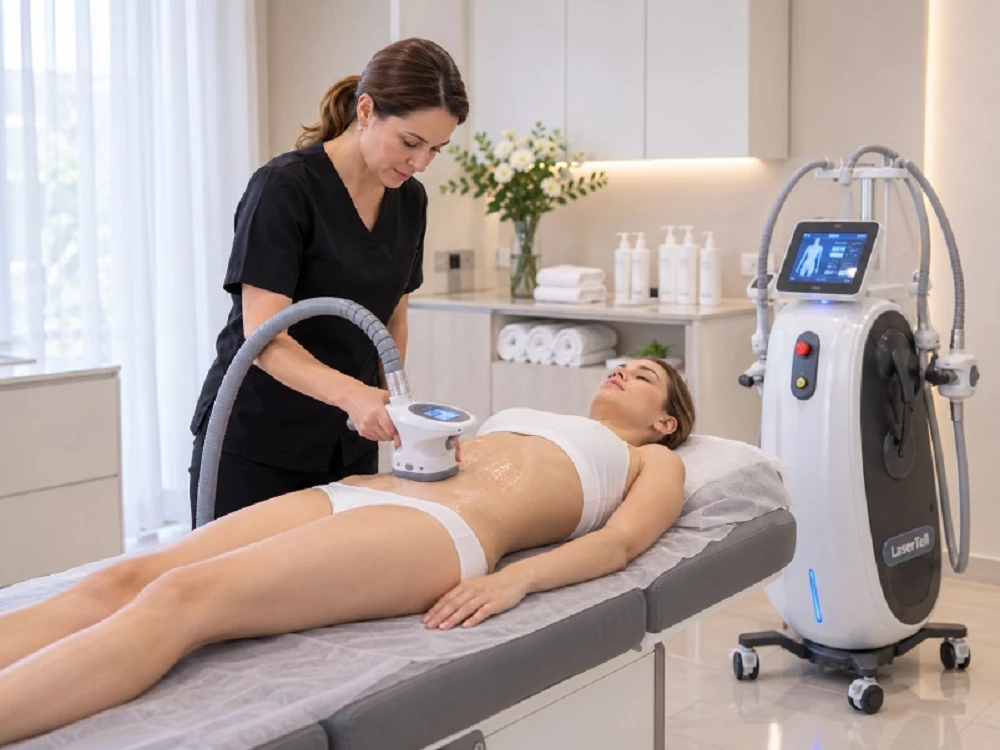
Radiofrequency is a current that changes direction millions of times a second. As it crosses tissue, resistance produces heat. With bipolar RF the current runs between two electrodes placed close together, so an operator can keep warming inside a defined zone. Heat in the dermis raises blood flow and encourages fibroblast activity, which is why practitioners reach for it when firmness is the goal.
Near-infrared light adds a shallower warmth, and its real value shows up before the RF even starts: warming the surface lowers the skin’s electrical impedance, so the current meets less resistance on its way to the connective tissue below. Devices built around this pairing are often sold as an Infrared Slimming Machine. As blood flow rises, oxygen separates more readily from hemoglobin and reaches nearby cells.
Suction sounds like a comfort feature, yet it changes the physics of the treatment. Once a handpiece draws the skin into a fold, RF meets a lifted layer rather than a flat surface, and operators can guide it to 5–15 mm while rollers keep the fold moving. That figure reflects a change in geometry as much as a change in power.
The rollers work at the same time: they stretch fibrous connective tissue, encourage lymphatic drainage and make fat cell clusters less viscous, so the area responds more evenly to heating. Equipment pairing suction with radiofrequency is commonly called a Vacuum Rf Slimming Machine, a label that signals a focus on depth rather than surface heat.
The third mechanism uses no heat. A cavitation handpiece sends low-frequency ultrasound into fluid-rich tissue, where tiny bubbles grow and collapse; that repeated motion places mechanical stress on nearby fat cell clusters. The category usually calls this a 40K handpiece, and in combined platforms the same applicator may carry a diode laser too. When RF, suction rollers and cavitation sit in one cabinet, you will sometimes see the longer name Ultrasonic Rf Vacuum Cavitation Machine.
The table below leaves numbers out on purpose, so you can compare what each mechanism is for.
| Energy | Where it acts | What changes in the tissue | Practical clue during a session |
| Heat from RF and near-infrared | Dermis and the connective tissue beneath it | Tissue warms, impedance falls, blood flow and oxygen delivery increase | Warmth builds gradually as the handpiece moves |
| Vacuum with mechanical rollers | A lifted fold of skin and the superficial fat layer | The fold changes the depth RF can reach; fibrous bands stretch; lymphatic drainage increases | The skin lifts and releases under the applicator |
| 40K ultrasound cavitation | Fluid-rich fatty tissue | Micro-bubbles place mechanical stress on fat cell clusters | No surface heating is needed for the effect |
Numbers still matter, though. RF power shows how much energy is available, while frequency shapes how the current behaves in tissue. Vacuum pressure sets how firmly the skin lifts, roller speed controls how fast that lift moves, and handpiece dimensions decide where an operator can work. None stands alone: a high RF output with an applicator too large for the face will not be usable there.
When the dimpled surface of cellulite is the main complaint, clinics tend to look for equipment sold as a Cellulite Slimming Machine, because the fibrous bands under the skin respond to lifting at least as much as to warmth.
None of these goals requires a different machine, only a different handpiece, setting or order of steps.
Once you know what each mechanism does, a combined platform looks like a sequence rather than a feature list. With the Plushape II, an operator can preheat an area, lift it into a fold and add cavitation in one room.
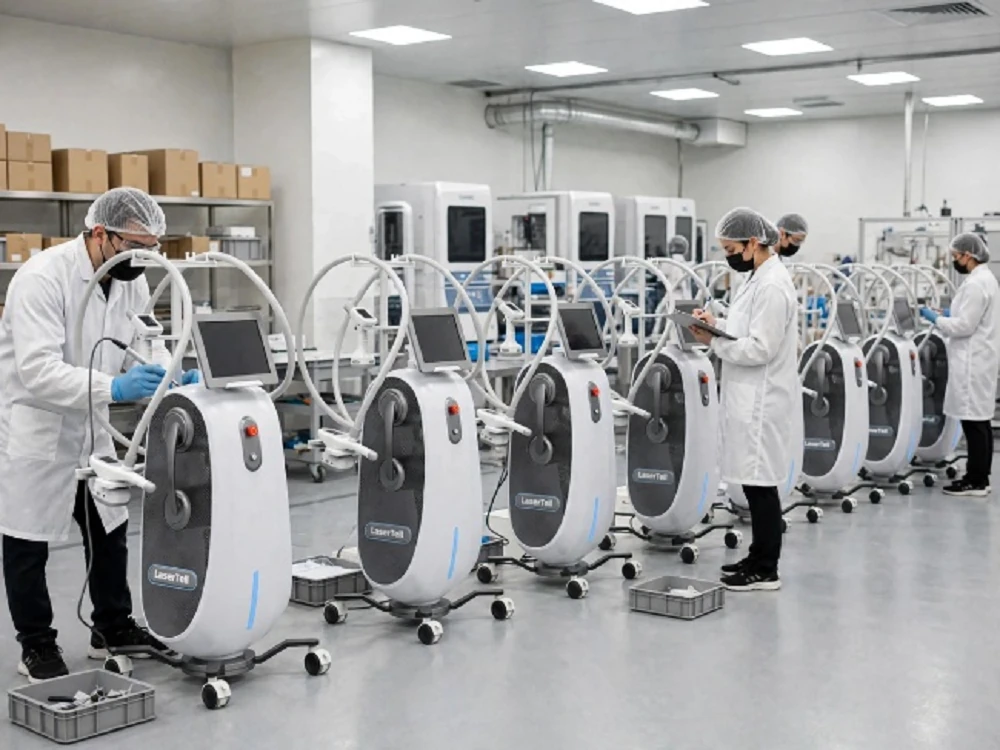
The four applicators are not four versions of the same tool. The body handpiece measures 80 × 40 mm and carries vacuum, a mechanical roller, bipolar RF and near-infrared light. The arm applicator, at 12 × 40 mm, keeps that combination in a narrower shape. The face handpiece, 14 × 3 mm, drops the roller but retains vacuum, RF and near-infrared light, and the fold technique is gentle enough for work around the upper eyelid area. A fourth applicator is a large 40K cavitation handpiece with a 635 nm diode laser.
Together they cover a wide treatment menu: wrinkle removal, body slimming, skin tightening, body shaping, skin lifting, cellulite reduction, eyelid area treatment, massage, a smoother skin surface and body circumference reduction. The handles sit comfortably in the hand, so a long session causes less operator strain.
Order makes the combination useful. Near-infrared light warms the surface first, so RF meets less resistance; as the current reaches connective tissue, oxygen moves more freely into the cells nearby. Vacuum then draws the warmed skin into a fold, and the rollers stretch fibrous tissue while RF travels to 5–15 mm. Lymphatic drainage increases, fat cell clusters become less viscous, and blood vessels dilate so oxygen and nutrients reach the area more easily.
Heat keeps working throughout: blood flow rises, oxygen leaves hemoglobin more readily, and fat cell metabolism increases while skin texture improves. Because one pass prepares the tissue for the next, a practitioner can deliver several effects in the time a single-technology device would need for one.
| Parameter | Value |
| RF type and power | Bipolar RF, 100 W |
| RF frequency | 10 MHz |
| Near-infrared power | 5–20 W |
| Vacuum | 0–100 kPa; working pressure 30–95 kPa; continuous mode |
| Roller speed | 0–36 rpm |
| Treatment handpieces | Body 80 × 40 mm; arm 12 × 40 mm; face 14 × 3 mm; plus a 40K cavitation handpiece with a 635 nm diode laser |
| RF penetration with vacuum and rollers | 5–15 mm |
| Power supply | AC 220 V, 10 A, 50 Hz or AC 110 V, 10 A, 60 Hz |
Read these figures alongside the mechanisms above and they start to mean something: a 10 MHz RF stage only helps once the skin has been prepared for it, while continuous vacuum keeps the fold steady throughout a pass.
It changes the appearance and shape of a chosen area, not body weight. Energy acts on the skin, the connective tissue and the fat beneath them, so a client can finish at the same weight with a firmer, smoother outline.
No. Heat raises tissue temperature and encourages fibroblast activity. Vacuum changes the geometry of the skin so RF reaches further, while rollers add mechanical stretching. Ultrasound works mechanically in fluid-rich fatty tissue without adding heat.
Because applicator size decides where it can be used. A large handpiece covers a broad area quickly, while a narrow one suits the face or the upper eyelid area.
Combined vacuum and roller manipulation brings RF penetration to 5–15 mm. Folding the skin makes that possible, since the current meets a lifted layer rather than a flat surface.
Yes, provided there is a dedicated facial applicator. A small handpiece with vacuum, RF and near-infrared light works gently around the eyes, and the fold technique suits even the upper eyelid area at a low setting.
Both AC 220 V, 10 A, 50 Hz and AC 110 V, 10 A, 60 Hz are supported, so the choice follows the local supply.
Heat, vacuum and ultrasound are often listed together, yet they solve different problems. Warmth changes how tissue behaves, suction changes how far that warmth travels, and cavitation adds a mechanical effect heat cannot provide. Seen as three steps rather than competing features, a combined body slimming machine reads like sensible clinic equipment instead of a long list of numbers.
That understanding also changes how you read a machine. Rather than asking which number is largest, ask which mechanism a treatment depends on, which handpiece delivers it, and how settings shift between a large area and a delicate one. Those questions reveal far more than a headline figure. Request the complete parameter list and handpiece configuration for the Plushape II before you decide how it fits your treatment menu.
 13Nov
 12Nov
 11Nov
 10Nov