How a Body Slimming Machine Works: Heat, Vacuum and Ultrasound Explained
Key Takeaways What a Body Slimming Machine Actually Does If you ask a practitioner what body contouring means, the answer may surprise you: nobody is...

Key takeaways
Four equipment factors matter more than headline power: the wavelength set, usable energy headroom, a spot range that covers small and large pieces, and cooling that lasts a full clinic day.
A tattoo lives in the dermis. To reach it, a laser beam passes through the epidermis first, and on darker skin that layer holds far more melanin. Melanin absorbs light across the visible and near-infrared range, so it competes with the ink for the same pulse. Everything that follows — wavelength, energy, spacing, aftercare — grows out of that competition. Clinics that respect it treat Fitzpatrick IV–VI skin well; clinics that ignore it produce the complications that make Laser Tattoo Removal On Dark Skin sound riskier than it is.
Melanin absorption falls as wavelength rises. At 532 nm, much of the pulse is captured in the upper skin before it reaches the ink; at 1064 nm most of it passes through, so the surface stays cooler and the dermis gets a clearer shot. Darker skin also carries melanin in a denser band along the basal layer, so any heat that does build up sits just beneath the surface. Settings that clear ink comfortably on type II skin can provoke a pigment response on type V.
Two complications matter more than any other. Post-inflammatory hyperpigmentation appears when the healing response stimulates melanocytes and the area darkens; it usually fades over months, though it can persist. Hypopigmentation is the opposite and the more serious of the two: enough damage to the melanocytes leaves a patch lighter than the surrounding skin, and that change is often permanent. Aggressive energy, overlapping passes and short intervals all push risk upward, and so does treating skin that is tanned, irritated or still healing. Scarring belongs on the same list, especially for keloid-prone patients.
A nanosecond Q-switched laser delivers energy slowly enough that heat spreads into surrounding tissue while the pulse is still running. A picosecond pulse finishes before that diffusion happens, so the ink absorbs the energy and breaks apart under acoustic pressure instead of cooking the skin around it. Shorter fragments are easier for the body to clear, which is why Picosecond Laser Tattoo Removal often needs fewer sessions than nanosecond work on comparable ink — and why it is gentler on the epidermis, exactly where the margin is thinnest.
Wavelength choice answers two questions at once: which colour of ink a pulse can clear, and how much epidermal melanin will intercept it on the way down. On lighter skin the first question usually decides. On type IV–VI, the second one does.
| Wavelength | Ink colours it clears | Behaviour on Fitzpatrick IV–VI | Practical rule |
| 1064 nm | Black, dark blue, grey; also dermal pigment | Weakly absorbed by epidermal melanin; reaches the dermis with the least surface heating | Default starting point on darker skin |
| 532 nm | Red, orange, yellow, some brown | Strongly absorbed by melanin close to the surface | Useful but least forgiving; reserve it for warm-colour ink |
| 755 nm | Green, teal, blue-green; certain pigmented lesions | Sits between the other two; more melanin interaction than 1064 | Worth having for colours 1064 leaves behind |
Black ink is the most common request in almost every market, and 1064 nm clears it with the least surface heating. That combination makes the long wavelength the default on darker skin, and it explains why a pico laser dark skin protocol looks narrower than the one written for type II patients: fewer wavelengths in play, lower energy, longer gaps. A large spot at 1064 also covers full sleeves and back pieces without the clinic pushing energy to make up for slow coverage.
Multi-colour work still needs the shorter wavelengths. 532 nm lifts red, orange and yellow; 755 nm catches green, teal and blue-green ink that 1064 leaves behind, along with several kinds of pigmented lesion. Neither is off-limits on darker skin, but both call for a test spot and a lower start, because the energy that clears ink and the energy that marks the epidermis sit close together. On type V and VI, clear what 1064 can reach first, then decide whether the remaining colours justify the extra risk.
Clinics differ in equipment and technique, yet the sequence that works on melanin-rich skin is fairly consistent.
Before any full pass, the assessment should cover skin type; the ink itself, whether amateur or professional, how old, how dense, whether it has been lasered before; and the patient’s history of scarring, keloids or pigment change. Medication and recent sun exposure belong in the same conversation. A test spot on an inconspicuous part of the design, treated at the intended settings and reviewed a couple of weeks later, turns guesswork into evidence. Pigment change at the test spot is information, not failure: it shows which way to adjust before a larger area is involved.
On darker skin, restraint outperforms aggression. Start below the threshold that provokes pigment, keep passes from overlapping, and read frosting — the immediate whitening that signals the pulse has done its work — as an endpoint, not a starting point. Anything beyond it, such as grey-white discolouration spreading past the treated area, is a signal to stop. Gaps between sessions should let the skin settle and any pigment response declare itself, which usually means longer intervals than a light-skinned patient needs. A clinic that quotes a fixed number of sessions before seeing the ink and the skin is guessing; the plan should come from a written protocol issued for that unit and that patient.
Aftercare carries as much weight as the treatment. Sun on a healing site is the most common cause of a pigment setback, so daily broad-spectrum sunscreen and physical cover matter for the whole course. Keep the area clean, moisturised and undisturbed, and leave blisters alone. Patients also need to know when to come back early:
When a clinic decides to add darker-skin tattoo work, the purchase question is rarely about peak power. What separates a laser tattoo removal machine that handles type V and VI skin from one that does not comes down to a short list of design choices, worth checking in this order.
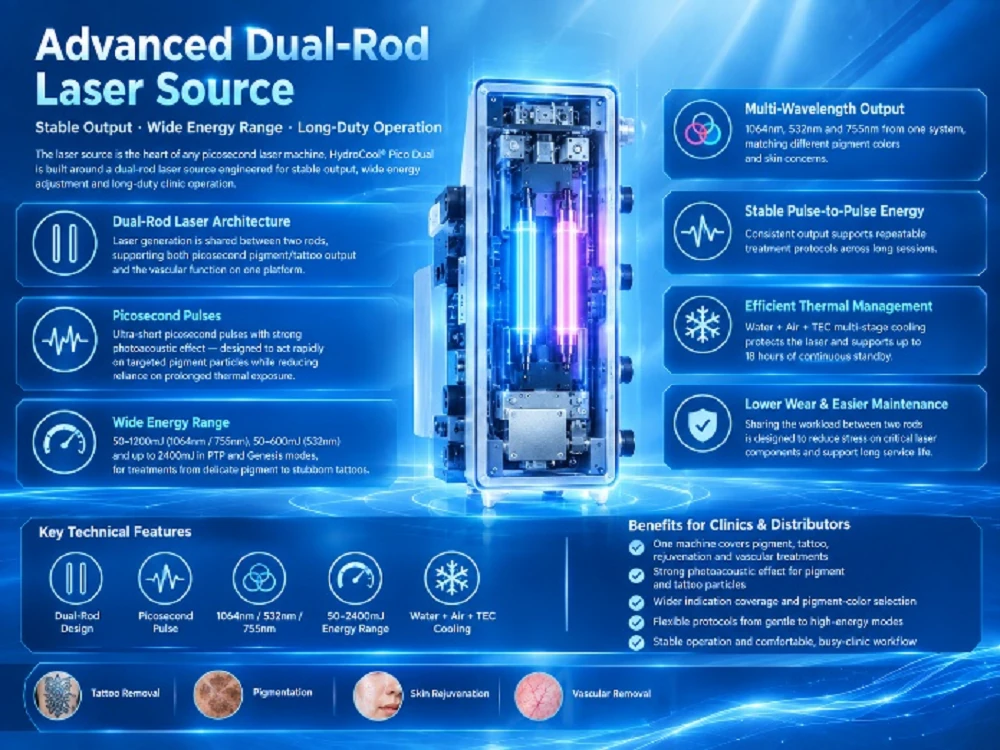
Cavity design sets the ceiling on output. A single-rod platform is built around one laser rod; a dual-rod platform splits the load across two. In design terms the second arrangement offers more energy headroom, which matters on dense, layered or large pieces and on days when the unit runs for hours.
| Single-rod platform | Dual-rod platform | |
| Cavity | One laser rod | Two laser rods |
| Output ceiling | Set by a single rod | Higher, shared across two rods |
| Best fit | Light pigment work, small and medium tattoos | Dense or layered ink, large areas, high-volume days |
| Trade-off | Smaller footprint, lower cost | Larger unit, and thermal design has to keep up |
Neither design is better in the abstract: a clinic treating light pigment will never use the reserve, while a busy clinic taking on heavy black coverage will feel it by mid-afternoon.
Energy figures do not pay for the machine, so run the arithmetic before the demo. Multiply monthly sessions by average price per session, then subtract equipment depreciation, consumables, operator time and a share of rent. Divide the purchase price by that monthly margin and you have a payback period. Session volume decides the outcome, and that is where the darker-skin segment earns its place: fewer clinics accept these cases, so the clinic that does faces less competition. Fill the model with local figures rather than borrowed ones.
For a clinic that wants one platform to serve both lighter and darker skin, the best laser tattoo removal machine is rarely the one with the largest number in the brochure. It is the one whose wavelengths, energy reserve and cooling line up with the cases the clinic actually takes. The HydroCool PicoDual was built around that brief.
The PicoDual runs a dual-rod cavity with three configurable wavelengths: 1064 nm, 532 nm and 755 nm. Output reaches 50–1200 mJ at 1064 nm and 755 nm, and 50–600 mJ at 532 nm. PTP and Genesis modes go up to 2400 mJ. That reserve lets an operator treat dense black coverage at 1064 nm without running the unit at its ceiling, then switch to a 2–10 mm spot for fine line work along the edges. An articulated arm and automatic probe recognition keep changeover short. Cooling combines water circulation, air and semiconductor TEC — the part that decides whether the tenth patient of the day gets the same output as the first.
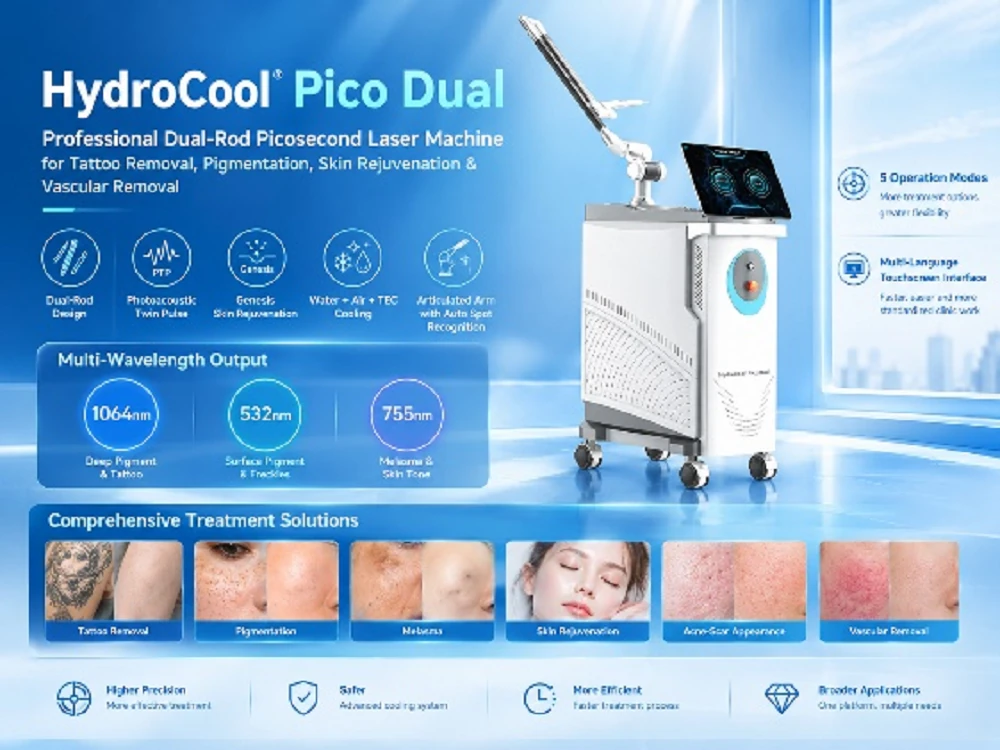
The operating modes share one head: picosecond delivery for ink and pigment, PTP twin-pulse output, Genesis for non-ablative rejuvenation, plus fractional and honeycomb work through compatible tips. That spread carries commercial weight. A clinic can sell tattoo removal, cosmetic pigment correction, eyebrow and lip line work, plus texture improvement from one investment. It can also serve the darker-skin patients competitors turn away alongside the lighter-skin patients it already treats.
For distributors and private-label brands, wavelength set, interface language and exterior can all be adapted, so one base unit can be positioned differently across markets without a second production line.
Safety depends on wavelength and restraint rather than on the device category. 1064 nm is the least absorbed by epidermal melanin and reaches dermal ink with the smallest heat load at the surface. Fitzpatrick IV–VI skin can be treated safely when the clinic starts conservatively, tests first and lets each session heal before the next. What it does not tolerate is a protocol copied from a lighter-skinned patient.
1064 nm targets black, dark blue and grey ink and reaches deepest. 532 nm targets red, orange and yellow, and melanin absorbs it far more strongly near the surface, which makes it the less forgiving choice on darker skin. Most multi-colour pieces need both; the order depends on the ink mix and the skin.
It matters where energy demand is high. Two rods in the cavity give the design more output headroom, which helps on dense, layered or large pieces and keeps the unit away from its ceiling during long days. For light pigment work the difference is smaller.
Yes, within the supported set: focus tips for tattoo and pigment work, a honeycomb tip, and larger spot or fractional options depending on configuration. The unit recognises a tip on connection and adjusts the interface, which shortens changeover and reduces setup mistakes.
Thermal design decides that. Water circulation, air cooling and semiconductor TEC work together here to hold temperature during continuous emission. Clinics running back-to-back sessions should still plan rest intervals and keep the cooling circuit maintained.
Yes. Wavelength configuration, interface language and exterior can be adapted for distributor and private-label projects, so one base platform can be positioned differently across markets.
Darker skin does not make tattoo removal impossible. It makes the margin narrower, and a narrow margin rewards preparation over power. The clinics that handle these cases well choose 1064 nm as their anchor, test before they treat, keep energy conservative and space sessions so the skin can report back. Wavelength range, energy headroom and cooling give an operator room to work carefully, yet no machine replaces the judgement behind the settings.
If you are building a darker-skin tattoo service and want a configuration matched to your market, contact the LaserTell team for a PicoDual consultation and the written treatment protocol that ships with each unit.
 13Nov
 13Nov
 12Nov
 11Nov