How Cryolipolysis Works and What to Look for in a Fat Freezing Machine
If you run an aesthetic clinic, a medical spa, or a body-contouring studio, you have watched demand for non-surgical fat reduction grow. Clients want visible...

· A clinic should evaluate wavelength coverage, pulse characteristics, output stability, safety, footprint, and supplier support as part of one purchasing decision.
· Peak power can help explain short-pulse laser performance, but it should be read together with pulse energy and pulse duration.
· A 1064nm + 532nm + 1320nm configuration can support a broader treatment portfolio than a single-wavelength platform, subject to the manufacturer’s intended-use documentation.
· Before purchase, buyers may check with the supplier on real-world output specifications and available technical, safety and quality-related documentation.
Choosing a Q-Switched Nd:YAG laser for a professional aesthetic clinic involves matching the machine’s specifications to its intended use. Wavelengths, pulse duration, pulse energy, fluence, spot size, repetition rate, cooling, and physical footprint all affect how practical a machine will be in daily clinic use. A purchase decision also needs to account for documentation, maintenance, training, and after-sales support. The ideal machine matches the clinic’s treatment needs, operating conditions and performance requirements.
Start with the services the clinic plans to offer. Tattoo removal may require multiple wavelengths, as tattoo inks differ in color and composition. For Q-Switched Nd:YAG laser tattoo removal, wavelength selection must be weighed against the pigment types the clinic expects to treat. Pigmentation-related procedures may also demand a distinct wavelength range. If the clinic wishes to incorporate additional aesthetic applications, extra wavelengths can enhance the platform’s functional capability. Accordingly, the intended treatment portfolio should be cross-referenced against the unit’s actual wavelength configuration before cost becomes the deciding factor.
A specification sheet should be interpreted as a group of interrelated parameters. A high maximum-power rating alone cannot indicate how the laser performs at the handpiece. Buyers should also review pulse duration, pulse energy or fluence range, spot-size options, repetition rate, output consistency, cooling performance, and supporting documentation for these stated specifications.
The 1064nm wavelength is commonly selected for darker tattoo pigments such as black and dark blue. It has relatively deep penetration compared with shorter visible wavelengths, which makes it a core wavelength for many tattoo-removal applications.
The 532 nm wavelength is generated by frequency-doubling the fundamental 1064 nm output. It is widely used for red, orange and certain light-toned tattoo pigments, together with superficial pigmentation procedures. Its practical value must be weighed against the clinic’s actual case mix.
The 1320 nm wavelength delivers an additional treatment option for specific aesthetic procedures. On a multi-wavelength platform, it expands the scope of services available to the clinic, without mandating a separate laser system.
For clinics that handle different tattoo colors and also provide selected aesthetic treatments, multiple wavelengths can make one machine more useful across the working week. That can simplify the equipment portfolio and potentially improve equipment utilization.
Pulse energy is the amount of laser energy delivered in one pulse, usually stated in joules (J) or millijoules (mJ). Pulse duration is the length of time that the pulse lasts, commonly stated in nanoseconds (ns). In simple terms, pulse energy tells you how much energy is in the pulse, while pulse duration tells you how quickly that energy is delivered. Buyers should look for clearly stated operating ranges and check where the values are measured.
For tattoo removal, sufficient pulse energy helps deliver enough energy to the target pigment for effective fragmentation, while a short pulse duration allows that energy to be released rapidly. Q-switched lasers use short, high-intensity pulses to produce photomechanical and photoacoustic effects that can break tattoo pigment into smaller particles for subsequent clearance by the body.
Peak power describes the power delivered during a short laser pulse. In a simplified calculation, peak power is pulse energy divided by pulse duration. This means that, at the same pulse energy, a shorter pulse produces a higher instantaneous power.
This matters because Q-switched tattoo removal relies on delivering intense laser energy in a very short time. Higher instantaneous power can contribute to stronger photomechanical and photoacoustic effects, helping to fragment the targeted pigment more effectively while limiting the time available for heat to spread into surrounding tissue.
For a clinic buyer, however, the number should not be considered on its own. Check the pulse duration, pulse energy, operating conditions, and exactly what the manufacturer means by the stated power figure—such as maximum equipment power or measured laser output.
| Parameter | What to verify |
| Wavelength | 1064nm, 532nm, and any additional wavelength offered |
| Pulse duration | Specified unit and operating range |
| Pulse energy / fluence | Adjustable range and measurement basis |
| Peak power | Definition of the stated power value and test condition |
| Spot size | Available sizes and whether the stated diameter is verified at the handpiece |
| Repetition rate | Frequency range under the stated operating conditions |
| Output stability | Evidence of consistent energy delivery during repeated operation |
A clinic may use the machine repeatedly throughout the day, so output consistency matters beyond the headline specification. The practical focus should be repeatable energy delivery, predictable parameter adjustment, and controlled beam delivery through the professional handpiece. These details are especially relevant when the same platform will be used across different treatment settings.
Maintaining steady energy output is critical as the laser runs over multiple treatment cycles. Even with well-set parameters, energy performance can shift under continuous use. Reliable, consistent energy directly impacts treatment results, so this practical performance factor deserves attention when comparing different laser platforms.
The handpiece is the part of the optical delivery path that the operator uses during treatment. Its design, beam delivery, and stated spot-size range should therefore be considered alongside the main machine specifications.
Stable operation supports more predictable parameter settings during repeated treatments. It also gives a clinic a stronger basis for troubleshooting when actual performance does not match the specification sheet.
At minimum, confirm the machine’s wavelength configuration, pulse duration, pulse energy or fluence range, repetition rate, spot-size range, and power specification.
· Actual output values and the measurement basis
· Energy stability during repeated operation
· Cooling performance for repeated clinical use
· Electrical requirements and operating conditions
· Machine dimensions and required service clearance
A professional clinic should review the documentation required for its target market and intended use. Before ordering, confirm which compliance documents, technical documents, and factory quality records the supplier will provide with the machine.
ISO 13485 is an international quality-management standard for medical devices. If a manufacturer is certified to ISO 13485, the certification relates to its quality-management system for medical-device activities. For a clinic buyer, it is useful to review this information together with the product’s market-specific compliance documents.
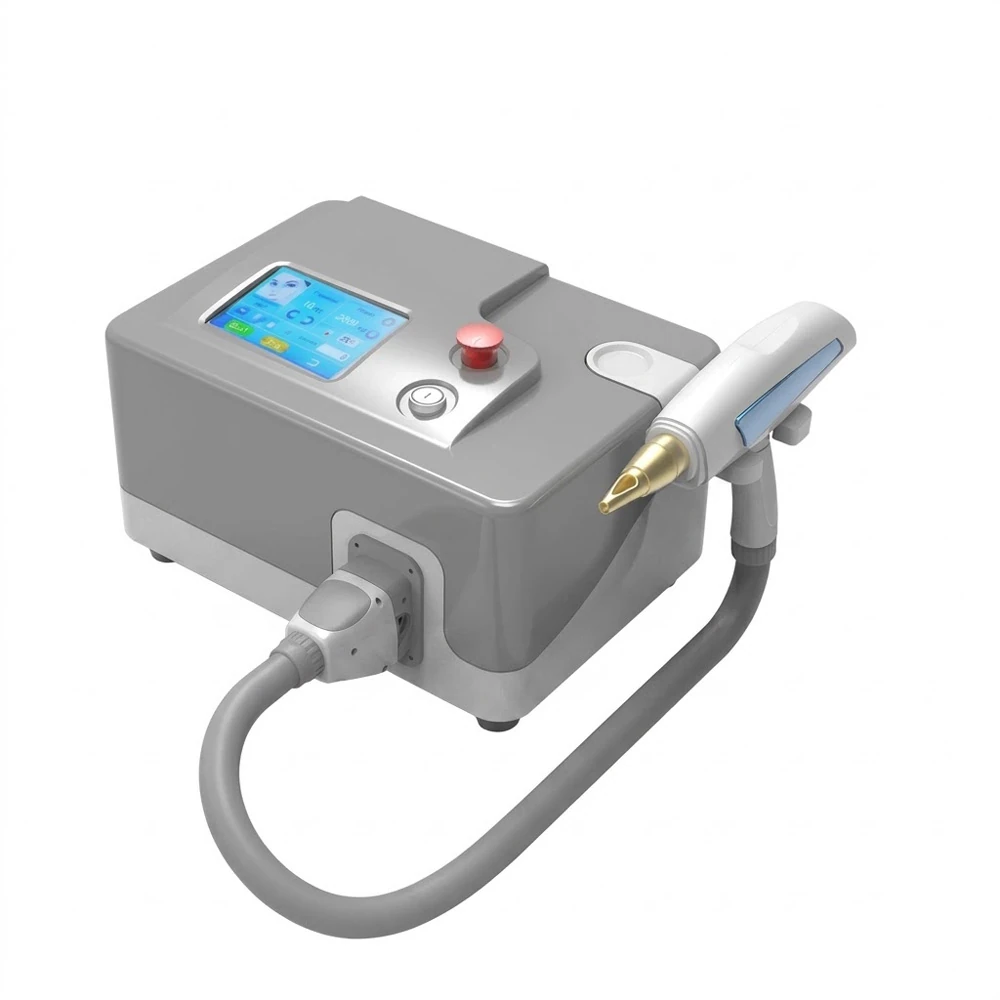
LaserTell’s Mini Q-Switched Nd:YAG Tattoo Removal Laser Machine combines 1064nm, 532nm, and 1320nm wavelengths. For a professional clinic, this configuration can cover darker tattoo pigments, red and certain lighter pigments, and aesthetic applications within one compact platform. The exact application range should be matched to the manufacturer’s intended-use information.
The machine measures approximately 36 × 40 × 50 cm, giving it a smaller footprint than many full-size clinic platforms. This can be useful for small aesthetic clinics, tattoo-removal studios, and treatment rooms where floor space is limited. Compact size is a practical advantage when the clinic still needs multi-wavelength capability.
The configuration is intended for tattoo removal, pigmentation treatment, and specified aesthetic applications. It features adjustable energy or fluence, repetition rate, and spot size according to the machine configuration, along with a professional handpiece and a cooling system designed to maintain stable operating temperature during continued treatments.
LaserTell provides complete, standardized laser safety documentation to support the assessment and control of laser radiation risks. Safety measures are incorporated into the equipment design, operating procedures, and supporting technical files. This documentation can help professional aesthetic clinics prepare for safety reviews and regulatory requirements in overseas markets.
Consider a small aesthetic clinic that offers tattoo removal but also receives demand for pigmentation-related treatments. The clinic has limited treatment-room space and does not want to allocate separate floor area to multiple laser platforms. A compact multi-wavelength Q-Switched Nd:YAG machine can give the clinic 1064nm and 532nm options for different pigment targets, while the 1320nm wavelength adds a further aesthetic application. In this type of setup, the main advantage is equipment versatility within a small footprint.
· Confirm the wavelengths required for the clinic’s main treatment categories.
· Review the machine’s output stability, cooling performance, electrical requirements, operating conditions, and footprint.
· Check the available safety, quality, compliance, user, and relevant factory documentation.
· Clarify warranty coverage, spare-parts availability, technical support, training, and service procedures.
A Q Switched Nd Yag Laser is a solid-state laser that produces short, high-peak-power pulses. It is widely used in professional aesthetic applications, including tattoo removal and selected pigment-related treatments.
A Q Switch Laser Tattoo Removal Machine is a professional laser system that uses Q-switched pulses to target tattoo pigments. Multi-wavelength configurations allow the operator to select a wavelength according to the pigment and treatment application.
1064nm is commonly selected for darker tattoo pigments, including black and dark blue, because of its wavelength characteristics and relatively deep penetration.
532nm is commonly used for red, orange, and certain lighter-colored tattoo pigments. It is also used in selected pigmentation-related aesthetic applications.
Nd Yag Laser Tattoo Removal uses short laser pulses to target tattoo pigments. Different wavelengths are selected according to the pigment and treatment application, while treatment parameters are adjusted based on the individual case.
For a professional aesthetic clinic, choosing a Q-Switched Nd:YAG laser means matching the machine’s wavelength configuration, pulse characteristics, output stability, footprint, safety information, and supplier support to the clinic’s actual requirements. Peak power can help explain short-pulse performance, but it should be interpreted together with pulse energy and pulse duration rather than treated as a stand-alone measure.
LaserTell’s Mini Q-Switched Nd:YAG Laser combines 1064nm, 532nm, and 1320nm wavelengths in a compact 36 × 40 × 50 cm platform. For clinics that need multi-wavelength flexibility in a limited treatment space, this configuration is worth evaluating against the clinic’s treatment mix, technical requirements, and local compliance needs.
Request the full technical specification, configuration details, compliance documentation, and quotation for the Mini Q-Switched Nd:YAG Laser Machine.
 23Sep
23Sep
 18Sep
18Sep
 17Sep
17Sep