How Cryolipolysis Works and What to Look for in a Fat Freezing Machine
If you run an aesthetic clinic, a medical spa, or a body-contouring studio, you have watched demand for non-surgical fat reduction grow. Clients want visible...

For aesthetic clinics, investing in laser equipment is not only a purchase decision but also a long-term clinical development strategy. With increasing demand for skin resurfacing, scar improvement, and skin rejuvenation treatments, fractional CO2 laser technology has become an important solution in many aesthetic and dermatology practices.
A Co2 Fractional Laser Machine uses controlled laser energy to create microscopic treatment zones in the skin while preserving surrounding tissue. Compared with traditional ablative approaches, fractional technology allows practitioners to adjust treatment intensity according to different skin conditions, treatment goals, and recovery requirements.
When selecting a fractional CO2 laser system, clinics need to look beyond basic specifications such as output power or device appearance. Factors including laser source stability, treatment flexibility, safety compliance, optical performance, and long-term reliability all influence the overall performance of the equipment.
A suitable Medical Co2 Laser Machine should match the clinic’s treatment goals, patient needs, and daily workflow. This guide explains the key factors clinics should evaluate before selecting a fractional CO2 laser system.
Before purchasing equipment, clinics should first define their primary treatment applications. Different clinical goals require different levels of precision, energy control, and treatment flexibility.
CO2 fractional laser technology is widely used for skin resurfacing because the 10,600nm wavelength is strongly absorbed by water-containing tissues. By creating controlled micro-treatment zones, the technology supports procedures related to skin texture improvement and collagen remodeling.
Common applications include:
For clinics focusing on CO2 Fractional Laser Skin Resurfacing, precise energy delivery is one of the most important considerations. The equipment should allow practitioners to adjust treatment parameters according to different areas and patient conditions.
Instead of selecting a system based only on maximum output power, clinics should focus on whether the equipment can provide stable and repeatable energy delivery.
Aesthetic clinics often perform multiple procedures every day, making equipment reliability an essential factor.
When evaluating a CO2 Laser Machine, clinics should consider operational efficiency, including cooling performance, system stability, ease of operation, and maintenance requirements.
For clinics located in regions with high temperature or humidity, environmental adaptability is also important. A stable cooling system and reliable electrical design can help equipment maintain consistent operation under different working conditions.
The laser source directly influences treatment precision and long-term performance. When selecting a fractional CO2 laser system, clinics should pay attention to the laser tube type, pulse response, energy stability, and service life.
A professional CO2 Fractional Laser Machine generally uses a 10,600nm CO2 laser wavelength.
This wavelength has strong absorption by water in biological tissue, allowing controlled laser energy delivery for resurfacing procedures. However, wavelength alone does not determine system performance. The stability of energy output and the accuracy of pulse control are equally important.
A reliable system should provide consistent control over:
These factors allow practitioners to adjust treatments according to different clinical applications.
The laser tube technology is an important factor when comparing different CO2 laser systems.
Traditional CO2 lasers may use glass tube technology, while advanced systems can utilize RF metal tube generators. RF metal tubes use high-frequency RF electric fields to excite laser gas, allowing faster pulse response and more stable energy delivery.
Compared with traditional designs, RF metal tube technology is often selected for professional medical applications because it can provide:
When choosing a Medical CO2 Laser Machine, clinics should evaluate the complete laser system rather than focusing on a single specification.
Fractional CO2 laser treatments require accurate energy distribution. Therefore, clinics should evaluate scanning flexibility and treatment precision in addition to laser output.
Different treatment areas may require different fractional patterns. A flexible system allows practitioners to select suitable treatment coverage for facial areas, scars, and other treatment zones.
Spot size is another important factor. A smaller focal spot can support precise energy delivery, while stable scanning performance helps maintain treatment consistency.
When comparing a CO2 Fractional Laser Machine, clinics should review:
These technical factors influence how effectively the system adapts to different clinical requirements.
Modern aesthetic clinics increasingly require multifunctional platforms that can support broader treatment programs.
A traditional fractional CO2 laser mainly focuses on surface resurfacing, while an Rf Microneedle Machine delivers radiofrequency energy into deeper skin layers through controlled needle penetration.
RF microneedling technology uses RF energy delivered through needles to target deeper tissue layers. The treatment parameters, including RF frequency and penetration depth, influence how practitioners customize procedures.
When CO2 fractional laser and RF microneedling technologies are combined, they provide two complementary approaches:
For clinics, an integrated platform can help expand treatment options while reducing the need to manage multiple separate systems.
The laser source determines the energy generated by the system, but the optical transmission system determines how efficiently and accurately that energy reaches the treatment area. Therefore, optical performance is an important factor when selecting a professional CO2 Laser Machine.
A well-designed articulated arm can improve treatment flexibility by allowing smoother movement during procedures. For practitioners, especially those performing treatments on different facial areas and body contours, arm flexibility can directly influence operation efficiency.
The quality of optical components also affects energy delivery. High-reflectivity mirrors and stable beam transmission help reduce energy loss during movement and support consistent treatment performance.
When evaluating an optical system, clinics should pay attention to:
A reliable optical system works together with the laser source to ensure that the energy delivered to the skin matches the selected treatment parameters.
Because laser equipment is directly used in medical aesthetic procedures, safety compliance should be an essential part of the purchasing decision.
A professional Medical CO2 Laser Machine should comply with recognized medical device standards and quality management requirements. Certifications do not replace clinical judgment, but they provide important information about the manufacturer’s production processes and safety control.
Key certifications and standards that clinics should review include:
In addition to external certifications, internal protection systems are also important. Laser equipment should include reliable monitoring mechanisms for temperature, cooling status, and electrical operation to support safe and stable clinical use.
Cooling performance is another important factor that affects long-term laser system reliability.
During repeated treatments, CO2 laser equipment generates heat, and an effective cooling system helps maintain stable internal operating conditions. For clinics with high daily treatment volumes, consistent thermal management can support continuous operation.
Environmental adaptability should also be considered, especially for international markets where temperature, humidity, and voltage conditions may vary.
A suitable system should provide stable operation under different working environments through technologies such as:
These features help clinics maintain reliable performance during daily clinical workflows.
Purchasing a fractional CO2 laser system is a long-term investment. Clinics should evaluate the overall value of the equipment rather than focusing only on the initial purchase cost.
A suitable system should provide a balance between treatment capability, operational stability, maintenance requirements, and future application potential.
For many aesthetic clinics, a multifunctional platform can provide advantages because it allows broader treatment options without requiring multiple independent devices.
However, the best equipment choice depends on the clinic’s actual patient demand, treatment strategy, and long-term development goals. A system with advanced technology is only valuable when it fits the clinic’s operational needs.
After evaluating the technical requirements of a fractional CO2 laser system, clinics can better understand which features provide practical clinical value.
The FemiMED NEO 10600nm CO2 Fractional Laser and RF Microneedling System combines fractional CO2 laser technology with RF microneedling technology in one platform. The system is designed for clinics that require both surface resurfacing capability and deeper dermal treatment options.
Unlike a single-function CO2 laser system, the 2-in-1 platform integrates a CO2 laser module and a gold RF microneedling module, allowing practitioners to select different treatment approaches according to clinical requirements.
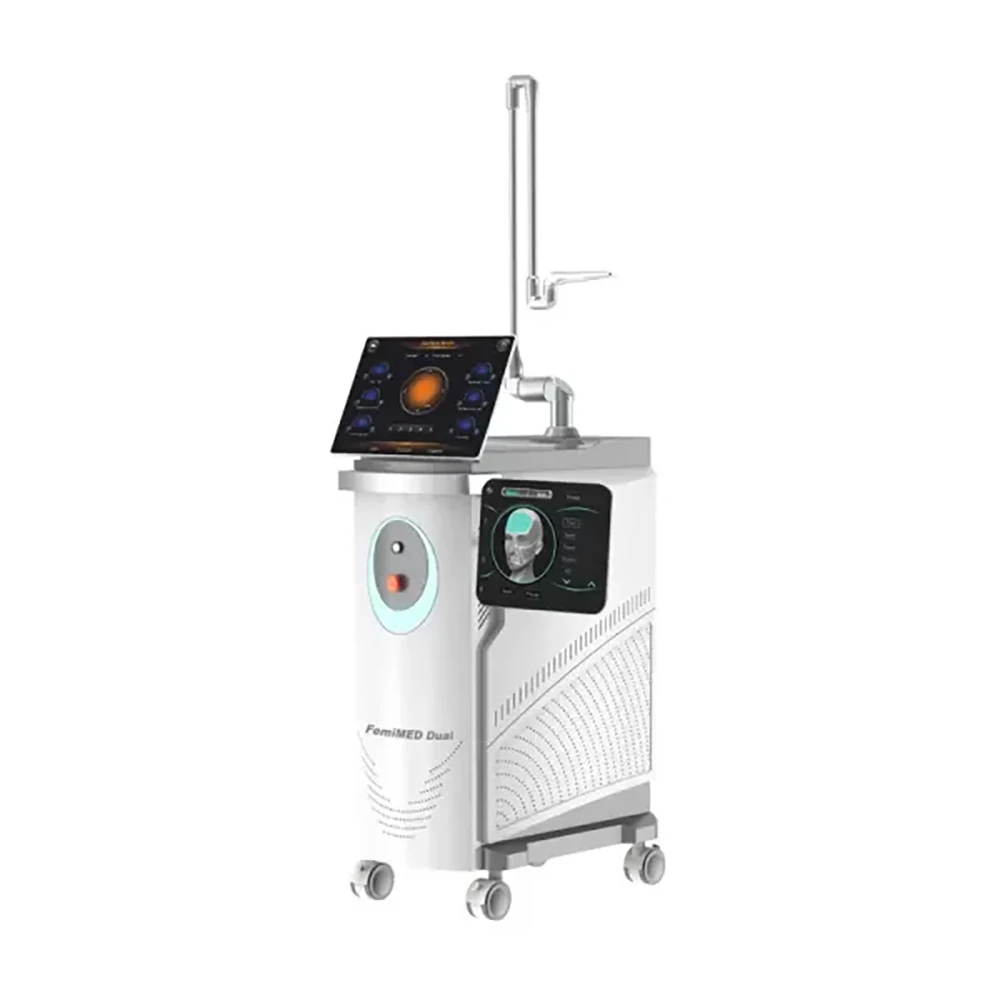
The CO2 laser module uses a 10,600nm wavelength and is equipped with a USA Coherent RF Metal Tube generator. The RF excitation technology helps provide fast pulse response, stable energy delivery, and precise treatment control.
The main CO2 laser specifications include:
| Specification | Details |
| CO2 Laser Wavelength | 10,600nm |
| Laser Source | USA Coherent RF Metal Tube |
| Maximum Output Power | 60W/70W |
| Single Pulse Energy | 1mJ–200mJ |
| Fractional Patterns | Square, Rectangle, Circle, Ellipse |
| Maximum Pattern Size | 20mm × 20mm |
| Focal Spot Diameter | <100μm |
The RF metal tube generator is designed with a lifespan of more than 20,000 hours, supporting long-term clinical operation. The system’s fractional pattern options allow practitioners to adjust treatment coverage according to different application areas.
The integrated gold RF microneedling module provides additional treatment flexibility by combining needle penetration with controlled RF energy delivery.
The module specifications include:
The system uses 24K gold-plated needles and stepper motor drive technology to support smooth penetration control. RF energy is delivered through the needle tip, helping practitioners customize treatment depth according to different clinical requirements.
The FemiMED NEO system is equipped with a Korean imported 7-joint articulated balance arm. The optical transmission system uses high-reflectivity gold-plated mirrors and is designed to provide efficient energy delivery.
The articulated arm provides:
For stable operation in different clinical environments, the system includes a closed-loop intelligent water cooling system with large-area heat exchangers. The design supports operation in environments up to 40℃ and 90% RH.
The system also incorporates voltage stabilization and surge protection for AC 110V/220V ±10%, 50/60Hz operating conditions.
A: When combining CO2 fractional laser and RF microneedling treatments, RF microneedling is generally performed first to deliver energy into deeper dermal layers, followed by fractional CO2 laser treatment for controlled surface resurfacing. The specific treatment sequence and interval should be adjusted according to the patient’s skin condition, treatment goals, and clinical protocol.
A: Compared with traditional glass tube technology, an RF metal tube can provide faster pulse response, more stable energy output, precise spot control, and a longer service life. When selecting a CO2 laser system, clinics should evaluate the complete equipment performance, including laser stability, optical transmission, cooling system, and safety design.
A: Clinics should choose a Medical CO2 Laser Machine based on factors such as laser source stability, treatment applications, safety certifications, cooling performance, and manufacturer support. The ideal system should meet the clinic’s current treatment requirements while providing flexibility for future service expansion.
Selecting a CO2 Fractional Laser Machine requires a comprehensive evaluation of technology, safety, reliability, and clinical application requirements.
A professional CO2 laser system should provide stable energy delivery, precise treatment control, flexible application options, and reliable long-term operation.
For clinics looking to expand their skin resurfacing and collagen remodeling services, a combined fractional CO2 laser and RF microneedling platform can provide a versatile solution. By carefully evaluating laser technology, safety standards, and operational requirements, clinics can make a more informed investment decision that supports long-term clinical development.
 23Sep
23Sep
 18Sep
18Sep
 17Sep
17Sep