Laser Hair Removal Business Profitability: A Break-Even Guide
Laser hair removal business profitability depends on whether finished treatments generate enough contribution to cover the costs your model includes. Equipment alone cannot establish a...

For companies working in the medical aesthetics and laser industry, few exhibitions provide as much insight into the development of the Middle Eastern and international aesthetic market as Dubai Derma.
For LaserTell, Dubai Derma has also become part of our own technology journey.
We participated in Dubai Derma in 2019, 2024 and 2026, giving us the opportunity to observe the market across three different stages of development. Over these years, we have seen not only new aesthetic laser technologies appear, but also a significant change in what clinics, doctors, distributors and aesthetic equipment buyers expect from professional devices.
The market has gradually moved from individual treatment technologies toward integrated, versatile and multi-technology aesthetic platforms.
Our experience can be summarized in three stages:
2019 — Technology-focused
2024 — Treatment-focused
2026 — Platform-focused
This evolution is also closely connected with the development of LaserTell’s own product portfolio, from professional fractional CO₂ laser systems to integrated CO₂, 1550nm Erbium and RF microneedling platforms.
Dubai Derma has developed into an important meeting point for dermatology professionals, aesthetic clinics, manufacturers, distributors and technology providers across the Middle East, Africa, the Indian Subcontinent and international markets.
According to the official Dubai Derma information, the 2024 edition brought together more than 1,500 international brands, 400+ exhibitors, 112 participating countries and more than 25,000 participants and trade visitors.
The 2026 edition continued this international scale, with the official event information highlighting 1,875 international brands, 114 countries and 25,000+ industry visitors across dermatology, aesthetics and laser.
For an aesthetic laser manufacturer, this makes Dubai Derma much more than a product exhibition.
It is an opportunity to understand where the industry is moving.
It allows manufacturers to hear directly from:
And most importantly, it allows us to compare what customers were asking for several years ago with what they are asking for today.
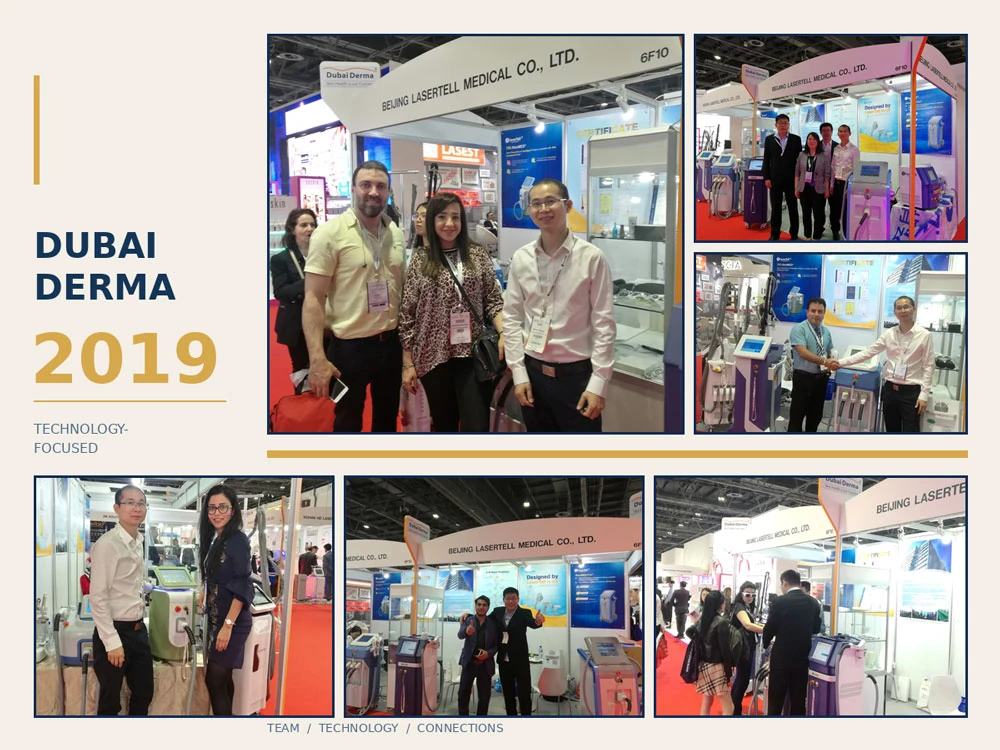
[IMAGE: LaserTell at Dubai Derma 2019]
Our participation in Dubai Derma 2019 represents an earlier stage of the modern medical aesthetic equipment market.
At that time, conversations around aesthetic equipment were strongly centered on the individual technology inside a machine.
Customers commonly wanted to understand questions such as:
This technology-oriented approach was reflected across several major categories of professional aesthetic equipment.
Fractional CO₂ laser technology was already an important part of professional skin resurfacing.
A 10,600nm CO₂ laser can deliver controlled ablative energy to the skin and is widely associated with professional applications such as skin resurfacing, scar remodeling and wrinkle treatment.
For manufacturers, the engineering challenge was not simply to produce higher output power.
It was to improve:
These engineering fundamentals remain important today.
Diode laser systems were another major category of professional aesthetic equipment.
The industry increasingly focused on wavelength configurations such as:
Different wavelengths offered manufacturers and clinics opportunities to develop treatment systems aimed at different hair and skin characteristics.
Over time, diode laser technology also evolved from relatively simple single-wavelength systems toward multi-wavelength diode laser platforms, improved cooling systems, larger spot sizes and more intelligent user interfaces.
Q-switched Nd:YAG laser systems remained an important technology category for pigmentation and tattoo-related applications, while IPL systems were widely developed for hair removal and skin-related treatments.
The fundamental business model was relatively straightforward:
One technology → One primary device → Multiple treatment applications within that technology.
This was the environment in which many professional aesthetic laser manufacturers built their foundations.
And for LaserTell, CO₂ laser technology would become one of the most important long-term development directions.
Five years later, the questions we encountered at Dubai Derma had changed.
By 2024, the industry conversation was increasingly moving beyond the basic question of:
“What technology does this machine use?”
Instead, buyers were asking:
“What can this platform help my clinic offer?”
This is an important distinction.
The development of medical aesthetic equipment was becoming increasingly focused on treatment versatility, clinical workflow, patient experience and equipment utilization.
The official Dubai Derma 2024 scientific program covered a broad range of dermatology, aesthetics and laser topics, while the exhibition brought together hundreds of exhibitors and more than 1,500 international brands.
Several technology categories had become especially important in the professional aesthetic equipment market.
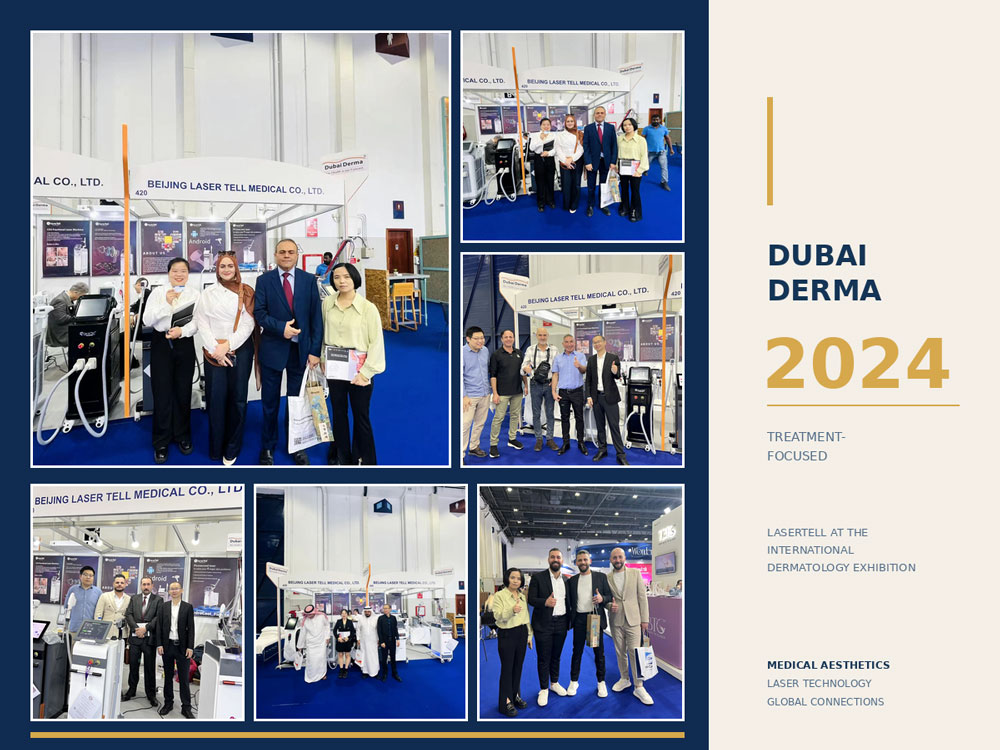
[IMAGE: LaserTell at Dubai Derma 2024]
CO₂ laser technology remained highly relevant, but the expectations surrounding the technology had become more sophisticated.
Customers were increasingly interested in:
The CO₂ laser was no longer simply a laser source mounted inside a machine.
It was becoming a complete treatment platform.
RF microneedling became increasingly prominent in professional aesthetic equipment.
Instead of relying on laser energy alone, RF microneedling delivers controlled radiofrequency energy into targeted dermal depths through microneedles.
This opened another route for applications involving:
More importantly from a product-development perspective, RF microneedling created an opportunity to combine different energy technologies within one workstation.
This was an important step toward the multi-technology platforms we see today.
HIFU also became an important category within non-invasive aesthetic treatment systems.
The market increasingly looked beyond traditional laser applications toward technologies that could support:
This reflected a broader change in the aesthetic industry.
Clinics were building treatment menus rather than simply purchasing individual machines.
Diode laser hair removal also continued to evolve.
Instead of focusing exclusively on one wavelength, manufacturers increasingly developed systems combining wavelengths such as:
755nm + 808nm + 1064nm
This approach provided greater flexibility for professional clinics and distributors serving different patient populations and treatment requirements.
The evolution of diode laser systems is a good example of the wider direction of the aesthetic equipment market:
More flexibility. More applications. More customization.
Picosecond laser technology also became an important area of interest for pigmentation and tattoo-related applications.
As with other laser technologies, buyers increasingly looked beyond the headline wavelength and asked about:
The market was becoming more technically sophisticated.
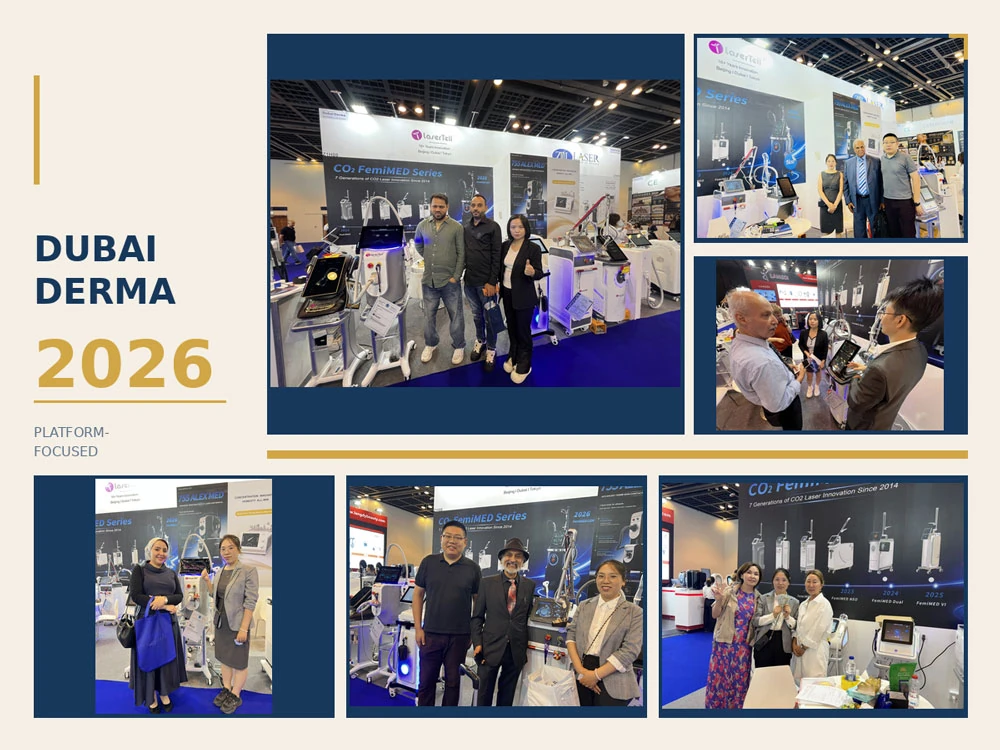
[IMAGE: LaserTell at Dubai Derma 2026]
Our third Dubai Derma participation in 2026 provided an interesting perspective.
After observing the industry over several years, one trend became particularly clear:
It is about making one platform more versatile, more integrated and more useful to a professional clinic.
This is where the concept of the multi-technology aesthetic platform becomes increasingly important.
Instead of:
One machine → One technology
the industry is moving toward:
One workstation → Multiple complementary technologies
The official Dubai Derma event positioning itself around dermatology, aesthetics and laser, together with its large international exhibitor and visitor base, reflects how broad the professional aesthetic technology ecosystem has become.
A clinic does not simply need a powerful laser.
It needs a treatment platform that can fit into its daily workflow.
This creates several practical considerations:
Can the system support multiple treatment approaches?
Can several technologies be integrated into one workstation instead of occupying separate areas?
Can doctors and trained operators switch between different treatment technologies efficiently?
Can one platform support a broader treatment menu?
Can different energy technologies complement each other rather than operate as completely independent devices?
These questions influenced our approach to product development at LaserTell.
After years of development in CO₂ laser technology and multiple generations of FemiMED systems, LaserTell has continued to move toward a more integrated concept.
Our new-generation 3-in-1 aesthetic platform integrates three technologies into one professional workstation:
The objective is not simply to place three technologies inside the same cabinet.
The objective is to create an integrated platform that gives professionals more flexibility when designing treatment strategies.
The 10,600nm fractional CO₂ laser remains one of the core technologies of the platform.
Fractional CO₂ technology creates controlled microscopic treatment zones in the skin, supporting professional skin resurfacing and remodeling applications.
Depending on the treatment protocol and applicable regulations, CO₂ laser systems can be used for applications associated with:
The engineering objective is controlled energy delivery.
For a professional CO₂ laser manufacturer, consistency is just as important as output.
The integration of a 1550nm Erbium Glass laser adds a non-ablative laser technology to the platform.
Compared with ablative CO₂ resurfacing, 1550nm technology can provide a different approach to dermal remodeling and collagen-related skin rejuvenation applications.
This creates additional possibilities for clinics looking to develop differentiated treatment protocols.
The combination is particularly interesting because the two technologies do not simply duplicate each other.
They provide different energy-delivery approaches.
The third technology is RF microneedling.
RF microneedling delivers controlled radiofrequency energy through microneedles into targeted tissue depths.
It can support professional aesthetic applications associated with:
By integrating RF microneedling with CO₂ and 1550nm laser technologies, the system becomes more than a conventional CO₂ laser.
It becomes a multi-technology aesthetic workstation.
The answer is not simply “three technologies are better than one.”
The real advantage is flexibility.
Different patients have different skin concerns.
Different clinics have different treatment philosophies.
Different markets have different regulatory and commercial requirements.
A multi-technology platform gives professionals the ability to select the appropriate technology according to the treatment objective, patient condition and applicable clinical protocol.
For example, a professional treatment strategy may involve different technologies at different stages rather than relying on a single energy source.
This is the concept behind our latest generation of product development:
One workstation. Multiple technologies. Greater treatment flexibility.
The development of this platform did not happen overnight.
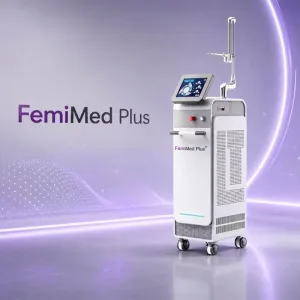
LaserTell’s FemiMED CO₂ platform has gone through multiple generations of engineering development.
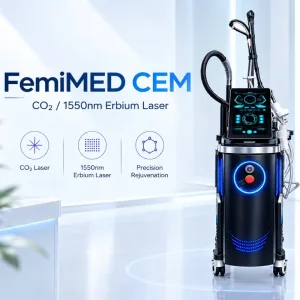
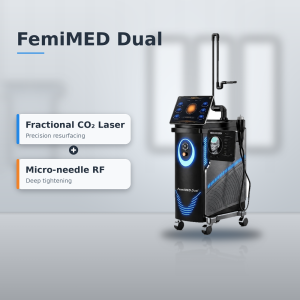
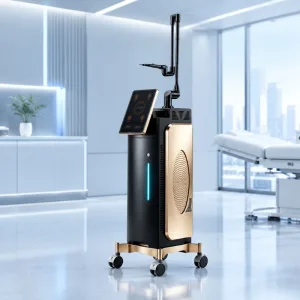
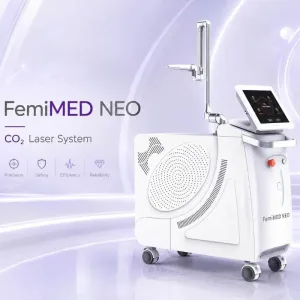
The first FemiMED generation was developed in 2014, followed by subsequent generations that progressively expanded system capabilities. FemiMED NEO introduced CO₂ and RF microneedling integration, while FemiMED Dual further developed the multi-modal platform concept. The latest FemiMED CEM integrates 10,600nm CO₂, 1550nm Erbium Glass and RF microneedling into one system.
This progression reflects an important principle:
Technology development is a process, not a single product launch.
Every generation gives manufacturers the opportunity to improve:
For LaserTell, this long-term engineering approach is particularly important.
Looking back at our participation in Dubai Derma 2019, 2024 and 2026, the evolution of the aesthetic equipment industry can be summarized in three stages.
The central question was:
“What technology does this machine use?”
Laser wavelength, power, pulse duration, cooling and hardware configuration were major topics.
The question increasingly became:
“What treatments can this machine support?”
CO₂, RF microneedling, HIFU, diode laser and other technologies were increasingly considered from the perspective of treatment versatility.
The question is increasingly becoming:
“How can this technology fit into my clinic?”
This means considering:
This is why we believe the next generation of professional aesthetic equipment will increasingly be defined by integration rather than simply specification escalation.
For LaserTell, Dubai Derma is not simply a place to display machines.
It is a place to listen.
Every exhibition gives us the opportunity to meet professionals from different markets and understand their requirements directly.
A distributor may focus on:
A clinic owner may focus on:
A doctor may focus on:
A successful aesthetic equipment manufacturer needs to understand all of these perspectives.
That is why exhibitions remain an important part of our product-development process.
The next stage of aesthetic technology will not necessarily be defined by a single “magic” wavelength or one extremely high power rating.
Instead, we expect continued development in several areas:
More technologies integrated into carefully engineered professional workstations.
More precise parameter management and more user-friendly interfaces.
Greater flexibility for different skin types, treatment objectives and clinical protocols.
More functions without unnecessarily increasing the footprint of the treatment room.
Equipment designed around the actual working environment of doctors and aesthetic professionals.
Products designed as technology platforms that can evolve through successive generations.
For manufacturers, this means that hardware engineering, software, optics, cooling, mechanical design and user experience must increasingly work together.
LaserTell is a professional manufacturer of medical aesthetic laser and beauty equipment, with product development covering technologies including:
Our current product portfolio reflects the same evolution we have observed at international exhibitions.
We are not only developing individual devices.
We are developing professional aesthetic technology platforms for clinics, distributors, OEM partners and aesthetic equipment businesses around the world.
Seven years can make a significant difference in the medical aesthetics industry.
At Dubai Derma 2019, the focus was strongly centered around individual technologies.
At Dubai Derma 2024, treatment versatility and complementary technologies had become increasingly important.
At Dubai Derma 2026, integrated multi-technology platforms have become an increasingly important direction for professional aesthetic equipment development.
For LaserTell, this journey is reflected in the evolution of our FemiMED platform.
From a professional 10,600nm CO₂ laser, to CO₂ + RF microneedling, and now to a platform integrating:
10,600nm CO₂ + 1550nm Erbium Glass + RF Microneedling
the direction is clear:
And our journey does not end with Dubai Derma 2026.
The next generation of aesthetic technology is already being developed.
Whether you are a dermatology clinic, aesthetic medical center, distributor, importer or OEM/ODM partner, LaserTell can provide professional aesthetic equipment solutions covering CO₂ fractional laser, diode laser, picosecond laser, HIFU, RF microneedling and integrated multi-technology platforms.
Visit LaserTell to explore our latest aesthetic laser systems and discuss your OEM, ODM or distribution requirements.
LaserTell — Professional Medical Aesthetic Laser & Beauty Equipment Manufacturer
 22Oct
22Oct
 21Oct
21Oct
 20Oct
20Oct
 19Oct
19Oct