How Cryolipolysis Works and What to Look for in a Fat Freezing Machine
If you run an aesthetic clinic, a medical spa, or a body-contouring studio, you have watched demand for non-surgical fat reduction grow. Clients want visible results without scalpels, anesthesia, or downtime, and cryolipolysis is one of the few technologies that deliver. This guide is for owners and managers researching their first cryolipolysis machine — the science, the parameters that matter, and the questions to ask before buying.
Key Takeaways
Cryolipolysis freezes fat cells until the body clears them; it contours a treatment area rather than producing weight loss.
Results appear gradually over roughly one to three months, so patient education matters as much as the device.
Cooling precision, applicator design, and vacuum safety matter more than the lowest advertised temperature.
Multi-handle systems shorten appointments and raise room utilization when simultaneous full-load performance is verified.
Buy documentation and support as much as hardware: warranty and service terms shape real cost of ownership.
Cryolipolysis is a controlled-cooling treatment that targets a pinchable pocket of fat and cools it long enough to trigger fat-cell death while leaving the skin, muscle, and nerves around it unharmed. The name breaks into cryo (cold), lipo (fat), and lysis (breakdown).
Because it works on a captured fold rather than the whole body, cryolipolysis is body contouring, not weight loss. A significantly overweight patient will not see the scale move; over time they will see a smoother contour in the treated area.
How Does Cryolipolysis Work?
Why Fat Cells Are More Sensitive to Cold
Fat cells, or adipocytes, are metabolically quiet and less resilient to cold than the tissue around them. When an applicator cools a fold to the right temperature, fat cells sustain damage while surrounding structures largely survive.
What Happens Inside the Body After Treatment
Cooled enough, a fat cell’s lipid crystallizes, damaging the cell and triggering apoptosis — a controlled form of cell death. The dead cell does not vanish on its own, however. Immune cells called macrophages clear the debris over the following weeks. Because that clearing is biological, results develop slowly: most clients see a change within a few weeks and the full outcome at roughly one to three months. Published studies report up to about 25 percent reduction in treated subcutaneous fat after one session, though results vary.
What a Treatment Session Looks Like
The practitioner places an applicator over the target area, and gentle vacuum suction draws a fold of tissue into the cooling chamber. An intense cold fades into numbness within a few minutes. After removal, the area is often red, swollen, and numb, but there is no downtime.
The Technical Parameters That Actually Matter
Cooling Temperature and Precision
Most professional machines operate in the low negative range — roughly -5°C to -11°C at the applicator. That number alone tells you little. What separates a professional system from a basic one is precision: how tightly the electronics hold the set point, how evenly the cold spreads, and how quickly sensors respond.
Applicator Design: 360° Surround Cooling vs Single-Sided Panels
Applicator geometry decides how much of the captured fold actually gets cooled. A single-sided panel cools tissue from one surface, while a 360° surround-cooling applicator wraps the cooling surface around a larger portion of the fold, exposing more tissue to the cold in one cycle. Check how the applicator matches the body area: a double-chin applicator needs a smaller, curved shape than an abdominal panel.
Vacuum Suction, Temperature Sensors, and Safety Controls
A session depends on tissue staying in place and temperature staying inside a safe window. A professional vacuum circuit should offer regulated suction, pressure sensing, and automatic release. Temperature sensors should monitor the skin or applicator interface, and the software should cut cooling or stop the cycle if it exceeds a limit. Look for treatment-log export and easy service access.
Table 1. Technical Parameters and What to Verify With a Supplier
Cooling temperature and range
How cold the applicator gets and how tightly it holds the set point
Whether all handles run simultaneously at full load
Refrigeration system
How heat is removed in long or repeated sessions
Air or air-and-water cooling, ambient limits
What Can Cryolipolysis Treat?
Common Treatment Areas
Abdomen
Flanks (love handles)
Thighs
Upper arms
Back and bra-bulge area
Submental area (double chin)
Who IsIt For?
The ideal candidate is close to a healthy weight, has a localized pocket of pinchable fat that resists diet and exercise, and has realistic expectations: a session reshapes the treated area over weeks to months. Some clients should wait. Pregnancy is an automatic pause, and people with cold-related conditions — cold urticaria, Raynaud’s syndrome, or cryoglobulinemia — need a practitioner’s assessment before any cold-based treatment. Rare complications exist too, including paradoxical adipose hyperplasia, where treated fat becomes firmer and larger and may require surgery. A cryolipolysis body slimming machine is only as good as the screening protocol that goes with it, so make screening and informed consent standard workflow.
How to Choose a Fat Freezing Machine for Your Clinic
Choosing a fat freezing machine for your clinic is a capital decision. Here is what actually decides whether it earns its place in your treatment rooms.
Cooling Coverage and Treatment Efficiency
Efficiency is how many clients move through a room in a day. A single-handle machine treats one area at a time, meaning longer appointments and more switching between areas. Multi-handle systems with several cartridges can treat multiple areas in one session — provided the supplier confirms full-load performance for all handles.
Safety Certifications and Build Quality
Before you accept any cryolipolysis equipment, verify the paperwork with the supplier, not the brochure. For Europe, ask whether the device conforms to the EU Medical Device Regulation (2017/745) and request the exact-model EU Declaration of Conformity. Check the electrical-safety and EMC reports against IEC 60601-1 and IEC 60601-1-2, and confirm quality-management certification such as ISO 13485. For the United States, ask how the model is cleared through the FDA — a 510(k) or another pathway.
Applicator Range and Treatment Versatility
The applicator lineup defines what you can sell. A machine that treats only the abdomen and flanks is a single-product service; one with a double-chin applicator and larger panels lets you build packages around thighs, arms, back, and the submental area. Because applicators touch the client, ask about cleaning requirements and replacement intervals.
Supplier Support, Training, and Warranty
The machine is only part of the purchase. Ask who trains your staff, what the training covers, and what happens when an operator leaves. Confirm the warranty length and what it includes — applicators, pumps, and consumables are commonly excluded — and get a spare-parts price list and response time in writing.
Meet the iCool: LaserTell’s 360 Surround Cooling Cryolipolysis Machine
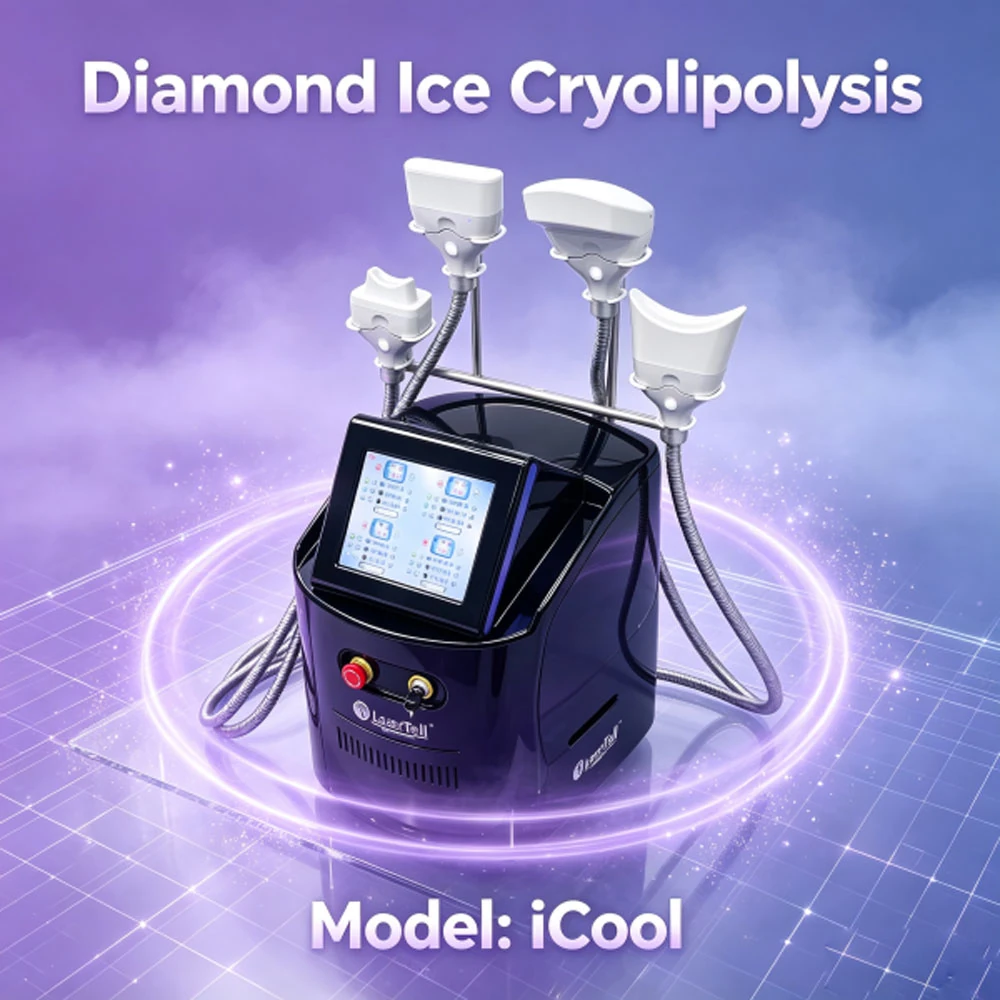
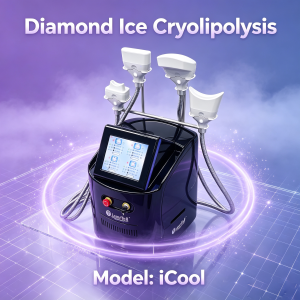
Once you know what to look for, the iCool from LaserTell deserves a closer look. Beijing LaserTell Medical Co., Ltd. has manufactured medical-aesthetic equipment since 2010 and serves customers in more than 80 countries, including OEM/ODM. The iCool — also labeled Diamond Ice Cryolipolysis — is a compact standing unit built around 360-degree surround cooling.
360° Surround Cooling for Even, Complete Coverage
The core of the iCool is its 360-degree surround-cooling design: the applicator exposes a larger portion of the captured tissue fold to cooling than a single-sided surface. The product explanation lists a typical cooling range of about -5°C to -11°C, and an air-and-water refrigeration system keeps heat rejection stable in long or repeated sessions.
Multiple Applicators for Full-Body and Double-Chin Treatments
The iCool offers four handles and six standard cartridges, with applicators of different shapes for the abdomen, flanks, thighs, upper arms, and double chin. The double-chin applicator matters: the submental region needs a smaller, curved shape a full-size panel cannot provide. A 10-inch wide color touchscreen controls the system, which runs on AC 110–220 V with a rated input power of 1,000 W.
Safety, Certifications, and Manufacturing Backing
LaserTell’s product page confirms vacuum suction and displays CE marking, and the company reports an ISO 13485 quality-management system. As with any device, request the exact-model EU Declaration of Conformity, EMC reports, and temperature and vacuum validation before purchase.
Training, Warranty, and Long-Term Support
The iCool comes with a one-year warranty, and LaserTell’s OEM/ODM experience means the export team works routinely with clinics and distributors on documentation and branding.
What This Means for Your Clinic’s ROI
The practical appeal of the iCool is capacity. With four handles and six standard cartridges, your team can plan treatments across multiple body areas.
Frequently Asked Questions
Is cryolipolysis safe?
Cryolipolysis is an established, non-invasive treatment when performed by trained operators on screened clients. Most reactions are temporary — redness, bruising, swelling, numbness. Serious complications are rare but real, including freeze burns, jawline nerve effects, and paradoxical adipose hyperplasia, so screening, protocol adherence, and consent are essential. For medical questions about a specific client, refer to a qualified practitioner.
Does fat freezing really work?
Yes, for the right candidates. Published research reports up to roughly 25 percent reduction in treated subcutaneous fat after one session, though outcomes vary. It is not a weight-loss method, so a client expecting a lower scale number will be disappointed.
How long do cryolipolysis results last?
Destroyed fat cells are gone for good in the treated area, but clearing takes time — usually over roughly two to three months. Remaining cells can expand with weight gain, so results depend on a stable diet and lifestyle.
How much does a fat freezing machine cost?
There is no single published number, because the fat freezing machine price depends on the configuration: handles and applicators, cooling technology, certifications, and training and support.
Can cryolipolysis replace exercise and weight loss?
No. Cryolipolysis is a contouring tool for localized fat, not a weight-loss method. The best candidates are already close to a healthy weight, and a stable lifestyle keeps the contour lasting. Position it honestly: a way to refine areas that resist diet and exercise, not a shortcut around them.
Conclusion
Cryolipolysis rewards clinics that do their homework: understand the biology and buy from a supplier that can document every claim. The iCool combines 360-degree surround cooling, four handles, six cartridges, and double-chin capability in a compact unit. To request a quote and the full technical specifications, view the iCool 360 Surround Cooling Cryolipolysis machine product page or contact the LaserTell team.
A Manufacturer’s Perspective on Fractional CO₂ Lasers, Diode Lasers, HIFU, RF Microneedling and Multi-Technology Aesthetic Platforms For companies working in the medical aesthetics and laser...
Key Takeaways What Is a 980nm Diode Laser Machine? A 980nm diode laser machine uses a semiconductor diode laser source to deliver near-infrared laser energy...
Key Takeaways What Is a HIFU Machine and What Is It Used For? A HIFU machine uses High-Intensity Focused Ultrasound to deliver focused ultrasound energy...
Key Takeaways What Is a 980nm Diode Laser Machine? A 980nm diode laser machine uses a semiconductor diode laser source to deliver near-infrared laser energy...