How Cryolipolysis Works and What to Look for in a Fat Freezing Machine
If you run an aesthetic clinic, a medical spa, or a body-contouring studio, you have watched demand for non-surgical fat reduction grow. Clients want visible...

Non-invasive aesthetic treatments have evolved rapidly over the past few years. Rather than treating one concern at a time, many patients now hope to improve pigmentation, redness, pores, and overall skin quality during the same visit. The question practitioners and patients are both asking is: can one device realistically handle this range of indications without compromising safety or outcome? Clinical experience and growing evidence suggest that a well-designed multi-application picosecond platform can deliver remarkably consistent results across multiple tissue targets, redefining what pico laser treatment means for the modern practice. Devices such as the HydroCool PicoMax™ illustrate this evolution, combining advanced pigment fragmentation, collagen stimulation, and—for the first time in many all-in-one systems—a dedicated vascular redness removal mode.
Pico laser treatment delivers energy in ultra-short pulses measured in trillionths of a second. Unlike traditional nanosecond lasers that rely predominantly on photothermal (heat-based) destruction, picosecond pulses generate a powerful photoacoustic (photomechanical) effect. These ultra-short pulses create shockwaves that break pigment into much smaller particles. A review in the Journal of Clinical and Aesthetic Dermatology noted that the ultra-short pulse duration minimizes thermal injury to adjacent structures, reducing the risk of post-inflammatory hyperpigmentation—a critical advantage when treating darker skin types (source: [https://www.ncbi.nlm.nih.gov/pmc/articles/PMC6122504/](https://www.ncbi.nlm.nih.gov/pmc/articles/PMC6122504/)). The same principle has also been adapted for selected vascular applications, where controlled energy spares the epidermis while selectively coagulating superficial blood vessels associated with telangiectasia.
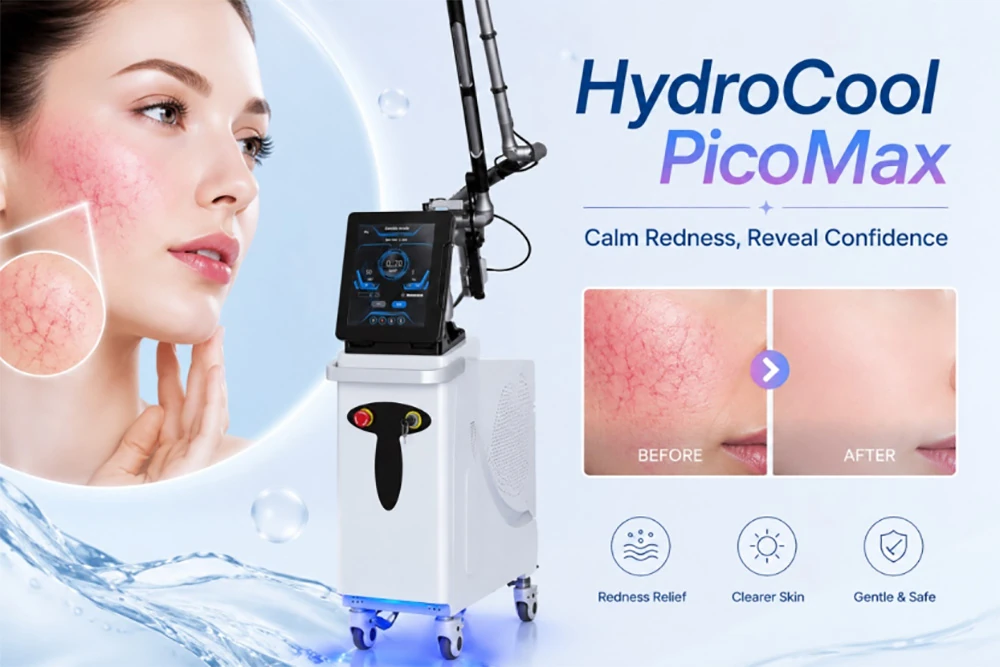
When the Picosure Machine (Cynosure) was introduced, it established the clinical value of picosecond-domain pulses for tattoo removal and pigmented lesions, and the term “Picosure laser pigmentation” protocol became widely recognized. However, the original device was primarily optimized for pigmentary and rejuvenation goals; vascular redness was not within its core design scope. Newer platforms have expanded on that concept by combining several treatment functions in one system. The HydroCool PicoMax, for instance, integrates the photomechanical benefits of picosecond technology with a newly engineered redness removal mode, enabling practitioners to treat diffuse facial erythema, spider veins, and post-inflammatory redness in the same session as a pigmentation protocol—without the need for a separate vascular laser. Picosecond technology remains an important benchmark for evaluating treatment performance, and new platforms aim to meet or exceed those standards while expanding the therapeutic menu.
Facial redness and visible blood vessels affect a significant portion of the population. The National Rosacea Society estimates that over 16 million Americans suffer from rosacea, with persistent erythema and telangiectasia among the most common symptoms (source: [https://www.rosacea.org/patients/all-about-rosacea](https://www.rosacea.org/patients/all-about-rosacea)). For years, vascular lasers like pulsed dye or long-pulse Nd:YAG were the workhorses, but they often require separate equipment and specific expertise. The HydroCool PicoMax’s redness removal mode selectively targets superficial vascular structures using a tailored energy profile, designed to improve the appearance of broken capillaries, diffuse redness, and rosacea-associated erythema while keeping epidermal temperatures controlled. The integrated HydroCool™ cooling system continuously manages thermal load, which can contribute to a more comfortable procedure and faster recovery. This allows practitioners to address several common skin concerns during the same appointment: addressing brown spots with pico laser treatment, calming vascular redness with the same platform, and then proceeding to skin texture improvement—all in a single appointment.
Understanding the treatment pathway helps patients set realistic expectations. While protocols vary by indication, a typical session may look like this:
1. Consultation and skin typing: The practitioner identifies specific pigment, vascular, and textural concerns, reviews medical history, and photographs the skin.
2. Cleansing and preparation: The skin is cleansed, and topical anesthetic may be offered for sensitive areas.
3. Parameter selection and test spot: The provider selects wavelength, spot size, and fluence based on the target chromophore (melanin, hemoglobin, or ink). A test spot may be performed.
4. Treatment delivery: The laser handpiece is passed over the skin. Patients often feel a snapping sensation. The cooling system runs continuously to minimize discomfort.
5. Immediate post–treatment care: The skin may look mildly pink or have a faint ash-gray appearance for pigmented lesions. A soothing gel and broad-spectrum sunscreen are applied.
6. Aftercare instructions: Patients are advised to avoid sun exposure, excessive heat, and active cosmetics for a few days while the skin regenerates.
Most patients require multiple treatment sessions. Pigmentation and redness often show progressive improvement over 2–4 treatments, while tattoo clearance depends on ink colors and density.
The differences become clearer when comparing picosecond lasers with traditional Q-switched systems.
| Feature | Nanosecond Laser (Q-Switched) | Picosecond Laser (e.g., PicoSure or HydroCool PicoMax) |
| Pulse duration | 10⁻⁹ seconds | 10⁻¹² seconds |
| Primary mechanism | Photothermal effect | Photoacoustic (shockwave) effect |
| Pigment fragmentation | Larger particles | Finer, more uniform particles |
| Thermal diffusion | Greater | Significantly less |
| Risk of post-inflammatory pigment change | Moderate in darker skin | Lower |
| Typical treatment sessions for tattoos | 6–10+ | 3–6 (varies by ink) |
| Built-in vascular mode | Rare | Available on all-in-one platforms |
This shift means that a single session can safely combine pigmentation clearance and collagen stimulation. When vascular redness mode is added, the device becomes a true dermatological multi-tool.
Based on the manufacturer’s published information and supported by clinical usage patterns, the HydroCool PicoMax is designed for a wide portfolio of indications, including but not limited to:
The device’s ability to pivot from picosure laser pigmentation-style protocols to redness-focused treatments without changing hardware addresses a long-standing efficiency gap in small to mid-size clinics.
According to the product overview, HydroCool PicoMax prioritizes clinical workflow through a large HD touch display, an intuitive user interface, and an ergonomic articulated arm. Consistent energy delivery and an advanced real-time cooling loop help maintain consistency across multiple patients. These features are intended to make treatments more consistent while helping clinics improve day-to-day efficiency. Modular components also make routine maintenance easier, reducing downtime. While exact wavelength and spot size ranges are best confirmed with the manufacturer’s technical datasheet, the system’s multi-handpiece approach allows customization for different skin phototypes.
Can one device really treat both pigmentation and vascular redness effectively?
Yes, but with nuance. A traditional single-function picosecond laser cannot. However, newer all-in-one platforms such as HydroCool PicoMax incorporate dedicated redness removal technology that delivers energy selectively to superficial vessels while retaining picosecond pigment clearing modes. This expands capabilities without adding a separate laser.
How many sessions of pico laser treatment are needed for pigmentation?
Most patients see visible improvement after 2–3 sessions, though stubborn melasma or deep dermal pigmentation may require additional maintenance treatments. Your provider should tailor the plan to your skin type and specific lesion.
Is pico laser treatment safe for darker skin tones?
Because the photoacoustic effect generates less heat than nanosecond lasers, the risk of post-inflammatory hyperpigmentation is reduced. The review in the Journal of Clinical and Aesthetic Dermatology (linked above) supports this safety profile, though individual settings must be carefully selected.
How does Picosure laser pigmentation removal compare with newer platforms?
The original Picosure Machine established strong clinical data for pigmented lesions and tattoos. Newer all-in-one systems aim to replicate or extend those results while adding vascular redness removal and integrated cooling. Direct comparison studies are limited, but the underlying physics of picosecond pulses remains consistent.
What is the downtime after a redness removal session?
When the cooling system is properly utilized, most patients experience mild, transient redness that subsides within hours to one day. Makeup can typically be applied the following day, and sun protection is essential.
Modern aesthetic clinics are looking for equipment that can do more without making treatments more complicated. Platforms such as the HydroCool PicoMax demonstrate how picosecond technology has evolved beyond pigmentation removal alone by combining pigment treatment, skin rejuvenation, and vascular redness management in a single system. While no laser is the ideal solution for every clinical indication, a multifunction platform can reduce equipment costs, simplify workflows, and broaden treatment options. As always, successful outcomes depend on careful patient selection, appropriate treatment parameters, and experienced clinical operation. For practices aiming to expand their service portfolio without investing in multiple standalone devices, an all-in-one picosecond platform offers a practical and flexible solution.


 23Sep
23Sep
 18Sep
18Sep
 17Sep
17Sep